So I've been reading something amazing on tumblr for awhile now, and it has reached a point at which I think it might be amazing even to people without the background to catch all the nuances, so I will speak of it.
Heimlichbourger's simblr is dedicated to detailing a "Test of Time Challenge," a style of play in which, by use of mods and rulesets, the player sets up a "prehistoric" neighborhood, with a limited range of items and interactions allowed, and attempts to build it organically into the typical roughly contemporary game setting by meeting specific criteria and playing through different eras with different mods and rulesets. It is, essentially, a way to play with the themes of games like the classic "Civilization" without losing the intense focus on individuals and domestic details on which Sims2 players thrive - a kind of soap opera worldbuilding. Far more people start than finish this difficult, long-term play challenge. Heimlichbourger added some refinements: three different geographical areas with three different types of sims - plantsims, ape sims, and werewolves - and three distinct social systems; and a ruleset that involves a bottom-up plan of development, so that instead of guiding sims through preconceived stages of civilization, the different cultures and histories develop according to the desires, behaviors, and characters of the sims responding to the challenges thrown at them by the game and the rules.
The result is epic, with myths generating themselves before the audience's eyes. If you only want to follow one simblr, follow this one, not mine - this is simultaneously something completely new in storytelling, and a harking back to the roots of all story.
Which sounds grandiose for something which, by its nature, will appeal most to a tightly niche audience. I believe that people who don't play this game will be able to appreciate what's happening here, because it is so good. But I know that only those who play the game themselves will appreciate it to its maximum potential, without being thrown off by things like sims in ape suits endlessly making potholders on a treadle sewing machine because that's the only way the game provides to simulate mastering the sewing skill enough to "unlock" tailored clothing. And quite a lot of people will be unable to get past such absurdities to appreciate it at all.
And this is fine. No one can like everything, and the fact that some people won't be able to make the mental accommodations necessary to enjoy something doesn't invalidate the quality of the work. My inability to fully appreciate (or even properly experience) classical music, or a basketball game, or grand master-level chess does not diminish the beauties of those things. The Grand Canyon will be an astounding sight, whether or not I ever go see it, or can bring myself to go down into it (balance issues would probably make the trip more terrifying than gratifying). Mathematical theorems that might as well be blank holes in the paper for all I am capable of comprehending them lose none of their beauty or elegance for my lack of comprehension. If a purpose for humanity exists, it must be to witness and give meaning to the world, yet a hummingbird migration is an event of wonder and joy, whether human eyes witness it or not.
Between human creativity and the natural productions of the universe, we live in a world comprised of more beauty, more cleverness, more sheer fun than any one of us can even hope to see, much less understand.
And that is a humbling, exhilarating, wonderful thing.
Showing posts with label gaming. Show all posts
Showing posts with label gaming. Show all posts
Tuesday, February 17, 2015


Wednesday, January 14, 2015
Characters: Gaming, Fiction, Life
So there's this guy who used to game with us. He made himself persona non grata in our house and Damon and I don't play with him anymore, but he's still in a group with someone else we know. (And if you're reading this, A - your feelings are about to get hurt, but I'd advise you to pay attention, because sometimes the way to self-improvement is through hurt feelings. If you had ever shown any sign of actively listening to me I would've said all this to your face long ago.)
He gamed with us for a long time, and for most of that time we didn't understand why he was showing up. And though he has not done any of the specific things there that have made him unwelcome in my home, we are still regaled occasionally with tales of what A did, in the other gaming group, to demonstrate that he hasn't changed. He brings an electronic device and does things on it rather than paying attention to the game. He comes late. He deliberately builds suboptimal characters that don't accomplish things in the game.
I have often thought, and several times remarked, that if you gave A a high-level, fully-optimized character and ran him alongside, or in direct conflict with, a low-level, poorly-optimized character played by Damon, Damon's character would still be the effective one. Because Damon would (grumbling all the way at the unfairness of it all) milk every advantage he could out of the character he had, that character's surroundings, the game mechanics, and the dice. A wouldn't even use the advantages that were spelled out for him on his character sheet.
I wish to be clear about something: I build suboptimal gaming characters all the time. I get my stats (in systems derived from D&D, four-d6-drop-the-lowest-and-arrange-as-desired is the one true character generation method; all others are cheats and imitations), I get the specifics of the campaign setting, a backstory sparks, I create a character, and then I do all the fiddly skill-building, power-assigning, equipment-buying stuff - in character. When we play Pathfinder, a D&D derivative whose creators believe heavily in "the build" as the be-all and end-all of character creation and combat as the main focus of the game, I sometimes feel crushed under the weight of the decisions that have to be made, and if I don't get Damon (who is great at manipulating systems) to help me I generally have a character who would die if not surrounded by combat monsters and healers. Even in a rules-light game like the current Deadlands campaign I mentioned a couple of weeks ago, I often find myself looking around for something Miss Cranthorp can do while the other characters are fighting. Put Miss Cranthorp into melee and she's at a loss.
But - and this is why people respond to Miss Cranthorp as an awesome character and to A's characters as bad jokes - if Miss Cranthorp can't fight she will volunteer to drive the train to free up the current driver for combat (and accidentally shake a bunch of mooks off the top of the passenger car before they can enter melee, suddenly putting the odds in our favor). A's characters, in a similar situation, will hide, or spend several rounds building up personal defenses while other party members are getting clobbered within arm's reach, or run away, or do nothing at all because A is watching cat videos or something on his laptop and the GM gets tired of trying to get his attention.
My characters are individuals who engage with other individuals in the game, with the setting, with the particular problem in hand. I inhabit them fully while I play them, and even if they die (which they tend not to, even in Pathfinder), people remember them fondly, and not as suboptimal at all. Being remembered well is a more important part of "winning" in RPGs - and in fiction - than is triumphing. Many a great gaming story ends in a Total Party Kill. Nor are Romeo and Juliet memorable for their ability to solve the conflicts presented to them by the plot!
A doesn't appear to inhabit his own character fully, much less the fictional ones under his control. He doesn't engage with the people around him enough to understand or even respect their points of view (which is how he got kicked out of my house). He doesn't understand the rules - of the game, of the story, of the society he lives in - well enough to use them, abuse them, or even effectually break them. He won't even engage his own problems, preferring to continue behaving in the same way endlessly amid people who don't know why he showed up and inevitably grow contemptuous of him.
Which is why I'm bringing him up. A no doubt has reasons for the behaviors he slouches along in. One reason we dealt with him as long as we did was that we assumed he had a lot of crap he was dealing with and that, as fellow borderline social-rejects, we were doing him some sort of good even though we couldn't see it, by providing a safe place to work through - whatever he was working through. But it's been more than 15 years and, if our friend in his current gaming group is to be believed (I have no reason to doubt him), he's still passively, stubbornly, even a little self-righteously, not doing the same old things he always never did. No meds, no therapy, no experimentation. No engagement.
An awful lot of life is just a matter of showing up and paying attention.
Maybe you don't understand the rules. You don't have to understand them to engage with them. To challenge them. To find your way through them. To bend them to your will.
But you require a will, first.
You have to have a character before you can create a character.
Are your characters flat and lifeless on the page? Are they boring? Are they whiny? Are they collections of quirks and flaws and virtues moving through the plot rather than people moving the plot around? Do they all sound like each other?
What about you? Are you showing up for your own life?
If you're not - it doesn't matter why you're not. Maybe your reason's good, maybe it's crappy; either way, it's preventing you from doing something you say you want to do, i.e. write well.
So what are you going to do about it?
Thursday, November 13, 2014
The Optimist at the Gaming Table of Life
So the gaming group tried something different last Sunday: Deadlands, with the Savage Worlds system, with a GM who doesn't play with us very often, who is less mechanic-focused than about half our regular group. It was October 1879 in an American West overrun with magic and monsters, and the party we assembled to go looking for a missing railroad crew in Donner Pass consisted of war-weary Confederate veteran Captain William Palmer, bounty hunter Mina Winchester, frontiersman "Texas Jake" Johnson, Father Patrick O'Flannery (who one of us - not me, surprisingly - said should be named Connor), and - schoolmarm Miss Agnes Cranthorp.
I kept thinking, as I put Miss Cranthorp together, that she was going to die horribly, or at least be a drag on the party. All her attribute points went into Smarts, Spirit, and Vigor; her skills were things like Intimidate, Guts, Knowledge, and Persuasion; she was near-sighted, loyal, strong-willed, and charismatic - and she couldn't hit the broad side of a barn with any of the weapons the others were carrying. Even Father O'Flannery had a sidearm and a hunting rifle. Miss Cranthorp had a carpetbag full of books, a good black silk dress, and school supplies, and we were all joking about how her favored weapon was a ruler. But from the moment I heard "Weird West" I knew my character was a schoolmarm. I'm used to playing the character who's the Least Valuable Player in terms of damage dealt, whose main function is to keep other characters alive or to distract the GM while the strategists and game mechanics experts devise plans. I play to be somebody besides myself for a few hours, not to indulge power fantasies. So I put together Miss Cranthorp (you're not engaged or related, you don't get to even think of her as Agnes!) with the mental reservation that she'd probably be dead at the end of the day.
Instead, the DM was making jokes about everybody else hiding behind the schoolmarm and Texas Jake was promising to buy her a yardstick when we got back to civilization. For one thing, I was rolling pretty hot - our opponents, a wendigo and the victims of its curse of insatiable hunger (yes, I know wendigo is an Algonquian monster, not something you'd normally find in the Rockies, but I guess for purposes of the module they'd spread across the continent or something) - could not touch Miss Cranthrop, and she was nailing almost everything she tried. She shook off the curse, she dodged wolves and bullets and claws, she was unshaken by cannibalized corpses or being surrounded by hunger-crazed railroad workers or even the wendigo himself and the zombies he raised to oppose us.
Her shining moment, however, came when we were surrounded by the hunger-crazed railroad workers. Two had shotguns, four had clubs, and they were all clearly intent on eating us. Miss Cranthorp had borrowed a shotgun, but she had never used one before and had probably never struck a blow in anger in her life. Also, both Texas Jake and Captain Palmer were also affected by the curse, though they had so far fought off the urge to kill and eat the rest of us. Our working theory was that consuming human flesh would change a cursed person in a fundamental way, and we had ample reason to believe that our opponents had crossed that line. So when she happened to be the first to be able to act in the round, I as player knew that she probably needed to just pull the trigger, that we would be forced to kill them all. But I as Miss Cranthorp knew that she had to try to talk them down, that if she survived she would not be able to live with herself if she didn't. So I took an Intimidate, describing her as pointing the shotgun in her best imitation of Miss Winchester, drawing herself up as straight as she could, and using the Teacher Voice to address one of the men with shotguns, telling him that we would find the source of the curse and break it, freeing them all from this awful hunger, but right now he needed to put the gun down. And once again, she nailed it - not enough to make him actually put the gun down, not then, but enough that the GM decided he lowered it, looked confused, and held back from acting.
This successful Intimidation changed the whole tenor of the encounter. If the cursed could respond to the Teacher Voice they were still human and probably not responsible for their actions; so everyone in the party immediately switched modes. Captain Palmer, who had been about to aim for the head of the other shotgun-weilder, went for a disarm instead; Father O'Flannery helped Miss Cranthorp take the gun away from the one she'd intimidated; Texas Jake and Miss Winchester used their weapons as clubs; and we soon had them all tied up and stowed, in varying states of consciousness, in a ruined cabin with furs tucked around them so they wouldn't freeze while we tracked down the source of the curse. Instead of killing them, we freed them; and since we had explicitly come to Donner Pass to find out what had become of them and help them if we could, this was by far the most satisfactory outcome and a big win for humanity.
This sort of thing happens all the time in games. It happens in stories, too, but in that case the dice are all loaded - the author has a desired outcome and that outcome will happen. The reader may shove that knowledge down deep into her head where it can't interfere with her enjoyment, but she does know that. In games, though, you've got honest die rolls, implacable mechanics, and a player who is or is not determined to play the character to the hilt and not give in till the last roll of the dice.
And here's the thing - I am the only optimist in my gaming group. I have a biological tendency toward depression, and being an optimist has sometimes been the only way I could get out of bed in the morning. Everyone else at the table is saying "TPK time" and "OK, I may as well start rolling up my next character," or acting on the worst-case scenario assumption, and my not-exactly-optimized character is saying: "Okay, I do this then. No? I try this then. No? Oh, hush, we can still pull this out. I try this then. Yes! Okay, that's a start, now I'm gonna do this."
I am not a better player than the others, not by a long shot. We have players who can make a system dance; who can finesse a build or pull a huge advantage out of an innocuous mechanic or solve an intricate puzzle in ways I can't even follow, much less do myself. My strength is in playing my character flat out, to the hilt, and to the bitter end. That's why, when five out of six party members were captured by cannibals, my rogue got away and returned alone to free them from the larder. That's why this Deadlands party is not made up of murderers. That's also why I also occasionally get into situations in which my characters get into head-to-head confrontations with other characters, over how to treat prisoners or who's in charge (not something I normally fret about, but that was explicitly Sofia's mission, dammit, and not only did he flout her authority he damn near got everybody killed doing it) or how to handle some delicate situation; but that's the breaks. It makes for an interesting game, anyhow.
And it's because this works in games that, when push comes to shove, I never can quite give up on something there is any chance of doing, or that nobody else can do for me. And why I get so frustrated with people who quit before they begin; who assume failure as the default state, or that because they failed once that's the end of it.
It's not over till it's over. Stay on the ride. At least find out where it's going.
Do you want The Thing, or not?
Thursday, October 30, 2014
I Keep Saying This in Different Ways
So anyway, I'm contemplating running a tabletop RPG again, which I haven't done in several years, and I'm going about it in this really backwards, sideways peculiar way. I described a vague setting to the players and asked them who they were in that setting; with their answers I asked some more questions and settled on a system, then produced more information; two of the prospective players have given me some solid character backgrounds, one has declared a class (the system chosen being class-based), one has given me enough background to give me a point around which to solidify the geography, and one is working Renfaire and hasn't given me much so far.
The idea here is to get as far away as possible from what we've been doing, as at least two of us are sick to death of the power creep, railroad plots, and sheer lack of story logic of the Pathfinder modules we've been running. I hope to create a low-powered, custom-tailored, sandboxy campaign that relies heavily on random chance, player initiative, and the GM's sense of story.
Because I kind of suck at game mechanics, but with supportive players who are good at the mechanics, I find, a sense of story logic serves pretty well, instead.
People are way too focused on learning how to do stuff. People trying to cook have meltdowns because there's an ingredient in an otherwise yummy-sounding recipe that they never heard of, or which is only available in large quantities and to use it up they'll have to search for other recipes that include it, and invariably those recipes have another ingredient...
People trying to write for publication want to know how to do it, what are the steps, what do I do next?
Would-be artists want to know how to draw, what's supposed to be in the portfolio, what will get them a commission?
And they don't want to do things until they know how they're done. Which often means, they wind up not doing it and eating another lousy meal out of a can.
Knock it off.
Yes, you need skills. Yes, if you want to go public there are protocols to follow. But - breathe, okay? You know how you learn to do things? You do them.
Recipes are not necessary if you know what you like and how to do a handful of basic cooking tasks. Write your story the way you need to write it, play your game the way it's fun, write and draw and film and snap photos and shove most of it in a drawer and write and draw and film and snap more photos. Burn a pie or two and throw it out and make another pie.
I'm making pants this week. I'm making the same pattern I made before, months ago, the ones I'm wearing today. That time, it took me three tries to install the zipper. I wrote a note on the pattern about it. You know how many tries it took me to install the zipper this time, notes and all? Three. I also cut the waistband the wrong length and had to rip it all off again when I thought it was all done but the hook, eye, and hem. So what? Next week I'm gonna have a new pair of pants that Miss Thai has not yet lovingly shredded during laptime. I could've had 'em this weekend, but what's the hurry? If I have to go to the farmer's market or the game in a pair of pants with cat claw snags all over them, anybody who notices will forget in five minutes and in any case what kind of person notices things like that and actually cares about them? Nobody whose opinion I respect.
I don't know how that game's gonna turn out. I don't know what we'll be doing in it in more than very vague outline. But I'm not on deadline, I know my audience intimately, and I'm quite sure that, even if it's a train wreck, we're gonna have fun and we're gonna laugh a lot.
My WIP is also kind of a train wreck. But there's a lot of potential there. Maybe it'll work, maybe it won't, maybe in the end this'll be the one that puts me on the roster of classics; or maybe no one but me will ever read it. But nobody's gonna read it if I don't write it.
Tuesday, October 28, 2014
"The Market" is Bunk
So I've had this thing to say ever since I read the New Yorker article about how Sims almost didn't happen and how it almost didn't have same-sex relationships in it. (Go read it; it's not long.)
I have been not feeling like expressing myself on this topic here, partly for a concatenation of personal stuff crap that has kept me from feeling like posting anything thoughtful at all, and partly because this blog primarily exists to give people who google me something dynamic to see besides my peripatetic newsgroup activity, which is mostly about Forteana and gaming. Since I expect (hope) at least some of the people who do so will be agents, editors, and other people in the industry deciding whether they want to have dealings with me, my strong opinion about What's Wrong with Publishing may not be the best thing to have turning up in that context.
But you know what? At this point, I have so little to lose, screw it.
What this article crystallized for me is the reality that the people in charge of marketing, in any given media industry, don't have a clear or realistic idea of what their market is.
In this specific article, two quotes from the interviewee stand out: “I guess straight guys that make sports games loved the idea of controlling two lesbians.” and "I don’t think they understand that family friendly can include gay people." The first sentence demonstrates that he participates in the same narrow construction of the audience that he complains of in the second. He is assuming that the reason the crowd at the game expo went wild over the incidental female/female kiss in the background of the Sims video was that they were all macho jerks with voyeuristic intentions; but that's a huge assumption to make even about the audience at a videogame trade show in 1999.
Time has shown that Sims players (and bear in mind that the Sims franchise is one of the most consistently profitable in the industry) are a dedicated, creative, patient, and overwhelmingly female bunch; to the point that I default to feminine rather than masculine pronouns when referring to players of unknown gender in a sims-fanbase context online, and am usually correct. He was at the trade show and I wasn't, so it's safe to say this wasn't the case with the industry people who saw the video and that most of them were, indeed, male; but it is hardly fair to assume that they wanted to "control lesbians" rather than being excited at the prospect of a full-life simulator that is flexible enough to allow a wide range of human behaviors. That, in fact, they were decent human beings attracted by a really cool concept with vast potential.
And yet, these same assumptions about the gaming audience are repeatedly made by marketers. I see them shooting themselves in the foot over and over in advertising. A great many people who had been excited about Sims4 dropped all intention to buy it when they saw a trailer apparently targeting antisocial 13-year-old boys; and those who did not do so were discussing ways to circumvent and mod out features that they found offensive or limiting (such as an "insane" trait) at the point that I blocked the "sims4" tag on tumblr. (Because heaven spare me from edition wars and I'm perfectly happy with my Sims2.) Yes, the misogynistic jerk gamer is a reality (google "Gamergate" and see!), just as Westboro Baptist Church is, but the one is no more a fair representation of the hobby than the latter is of Christians. (And by the way, why would you want to cater to a morally bankrupt marketbase like that when you can market to people you'd like if you met them?)
We see the same thing over and over and over, where ever media are sold. I was in a panel at last year's World Con devoted to the question of why a certain niche market wasn't filled, and the panelists kept coming back to "there isn't a market" even when the market stood up in front of them and said "Here I am." I cannot hear "There isn't a market" or "the market doesn't want" or any such similar constructions, said by anybody, and not hear: "I don't know how to sell to that market and am not interested in learning."
I would like to say at this time that I do not feel victimized by this as a writer. Do I think big publishers could do a better job of promotion for the books that need it the most? Sure; and this has included me in the past; but that has nothing to do with me at the moment. Even if it contributes to the reasons why I'm not selling any new books right now, it would only be a small part of my problem.
I do occasionally, however, feel victimized as a reader. I'm a lot closer to the assumed core book market than a lot of people, and I never have a shortage of stuff to read, or come out of a bookstore without an uneasy feeling that I shouldn't have spent so much; yet even I get tired of heterosexual romantic interests, white characters, fantasy worlds based on medieval Europe, and a whole cluster of assumptions about what will appeal to me based on the idea that I'm from either California or New York, white, middle-class, and unwilling to try too hard to understand an alien viewpoint; or that, if I'm not like that, I fantasize about being that way and can easily identify with a type of person who could not be expected to identify with me. If even I feel slighted and confined, how much worse must it be for people who are dismissed as not being part of the market at all?
It's true I'm a crappy marketer myself. I don't know how to sell stuff; because the moment anyone tries to sell me something, I don't want it. I want to find things for myself. I wouldn't presume, in the normal course of things, to tell somebody else how to do their job, especially when I know their job is one I couldn't do.
But in this instance - I'm right.
And I may not know how to solve this problem; but I do have enough faith in marketing people to believe that, if they can have that epiphany and realize that they are defining the products they represent right out of a huge potential for growth, they can learn how to change their approach to exploit that potential.
Tuesday, August 5, 2014
Your Body Doesn't Know It Isn't Happening
This weekend, our gaming group was playing along in our game as usual, having narrowly escaped death at the fangs of a gargantuan tarantula; when the Non-Player Character, of dubious allegiance, with which we were dealing tried to pull an obvious cover-up, which his degree of authority in the situation should have allowed him to do. But Stephanie Neotomi, my ratfolk rogue (recently recovered from being paralyzed by the venom of said spider), had already started asking questions and wouldn't be put off. Suddenly everything devolved into a shouting match, violence was narrowly averted, and we spooked the NPC badly enough that he had to run; but the guards under his command were already moving to arrest us.
After a hairy bit of play, we emerged with the evidence we needed to get the guards on our side, the information we needed to advance our mission, and with all party members alive - but two of us probably infected with lycanthropy and nothing with which to stop the infection. So we had to ride hard in the opposite direction from where we wished to go in order to get some wolfsbane - ride so hard that it was necessary to stop and perform some magic to keep the horses from floundering on the way back. Which is when the ghost of one of the random monsters we recently killed decided to attack us, coming within a hair of killing three of the party. Again, we emerged victorious, but only by dint of some serious cooperative play and one of us remembering a resource that we've had for awhile but which the rest of us had forgotten. Also, the DM letting him deploy that resource retroactively, so that our sorcerer was only mostly dead.
By then it was late enough that we needed to quit, so the game broke up. Once home, I crashed hard. We all agreed, in e-mail postmortem on Monday, that the session had been intense enough to be physically draining. Sitting around a table rolling dice, making notes, and pawing through rulebooks looks sedentary; but the intellectual and imaginative handling of the scenarios and rules, and the sheer suspense, activated plenty of adrenaline and had significant effects on our body chemistry. That night I was in that peculiar state of exhausted wakefulness that you get on your most strenuous days of vacation, when you can't stop shooting the rapid or climbing the mountain or riding the rollercoaster, or whatever it was you were doing that had your body convinced that you were about to die, even though you were perfectly safe.
The same thing happens when you're writing. Or reading, but there's a level of control in reading that you don't have in writing. You cry real tears over Beth March, but you don't have to deal with it all at once. (Remember how Joey, on Friends, used to put intense books - including Little Women - in the freezer when he couldn't handle them?) When you're writing, you're writing pretty much constantly. When you're doing dishes. When you're in the shower. When you're watching TV or driving or kissing your husband. Your backbrain is handling the material, going over it and over it to get it into a form you can write down; and then you write it down and you have to bull your way through it to get the draft and then - you'll have to revise it. And go over and over and over it. To top off which, even the most comfortable writing posture, over time, involves being locked into place for a prolonged period, which is physically taxing. (So cultivate good habits, like pacing and taking little breaks. At least get yourself an ergonomic keyboard. You'll kill yourself typing on a laptop.)
I had to rewrite the ending of The Ghost Sitter five times for the editor (I didn't count how often I went over it in revision before she even saw it), and I cried every time.
So don't be surprised if you get up at the end of a writing session shaky and weak and exhausted.
Writing only looks sedentary. It has physical effects. Don't discount them. Accommodate them.
Tuesday, May 27, 2014
House Rules
For the first time in a long time this Memorial Day weekend, everyone in my gaming group had the same three days free. Three days! Gamingpalooza!
We had a couple of pretty intense roleplaying sessions. Without going into details that would make the eyes of non-gamers glaze over, we were experimenting with pushing back against the tendency of the Pathfinder Adventure Path system to force players into a min/maxing style of play which is alien to us. We ran an underpowered three-person party a couple of levels higher than the module writers recommended, with the addition of an unfamiliar optional set of "mythic powers." The mythic powers could easily have overwhelmed the scenario if handled poorly, and they appear to have been designed merely as a new way to increase "power creep" (the ongoing arms race between players and game masters, requiring constant escalation of increasingly complicated and burdensome game elements), of which we are heartily sick. However, the game master gave them to us in such a way that, though we got to control which ones we got, we felt obliged to play them as complete surprises which our characters did not know how to use and didn't feel they could rely on. So while we as players knew that we had a safety net, our characters were making plans and devising strategies that did not take these safety nets into account, and pulling mythic powers out only when we felt cornered by the introduction of unknown factors or pressed by the inevitable disruptions of our plans. Only toward the end, when the Big Bad was defeated, did we feel entitled to start experimenting with them.
The result was that we felt challenged, engaged, and endangered constantly, but did not lose a character. One random encounter almost did us in; one programmed encounter was subverted and turned into a cakewalk due to our proactive data-gathering and sensible use of resources (and we were entitled to the cakewalk because we were proactive); the climax was climactic (which is not always the case); and my character developed what might be called learned pyrophobia, which is the sort of thing that I love best about role-playing games; i.e., the chance to temporarily be another individual with a distinct life experience. We did not get any of those jawdroppingly great moments when everyone is surprised, but we had a lot of fun.
None of us is under the illusion that this particular experiment is a panacea for our problems with Pathfinder. It's obvious to even the most system-mechanically-challenged of us (i.e., me) that the particular combination of solutions implemented here would not work with every adventure path, or every set of characters. But I think we are on the right track. The rigidity of Pathfinder compared to other systems we've used, and the adherence of their Adventure Paths to formulaic structures, has hypnotized us into experimenting and enjoying ourselves less with them. I think we need more house rules. I think we need to use some of the Paths as sourcebooks instead of as modules, make more choices that thumb their noses at the power gamer expectations of the system, alter the structures given to us. We need to do this as players and as GMs, in cooperation and adjusting our approach to our circumstances. As a gaming group we have always been pretty good at this in play. I think we need to go "old school" in prep, too. Stress less, improvise more.
I often see people lock themselves in like that. A writer reads The Hero's Journey and mutilates her story to fit it, as if the structure of the Journey were a universal ideal toward which all stories must strive. An artist learns some useful techniques, and keeps using them even when they are less useful. A player gets bored with his playstyle and assumes he's bored with his game. A person leads a meaningless life, continually striving to hold on to a job she doesn't like to pay for a car she doesn't enjoy driving and buy her kids toys they don't play with. A citizen declares loyalty to a country and clings to that loyalty long after the country has proven itself disloyal to him.
Why do we do this to ourselves? It's depressing.
So cut it out. When you need a house rule, make one. When you don't, don't.
You can be happy and do good work, if you let yourself.
Tuesday, April 22, 2014
Railroad, Sandbox
Between the messy process of writing the current book and figuring out exactly what the plot is as I go, and various gaming situations, I've been thinking a lot about the railroad vs. the sandbox.
A game has a "railroad" plot if there's only one correct way to finish it - if you need to put all the elements together in the correct order in order to win. Most videogames are of this variety, because it's so well-suited to the way computer programs behave. The more choices a player has, the complicated the program has to be, and in any program there's an upper limit to the choices that can be allowed. The pleasure of these videogames is at least partly the pleasure of learning and implementing the optimal set of choices. It's almost like formal dancing - without the full-body movement, and I'm not sure how well the soundtracks of these games are synched to the rhythms of the winning strategy.
A "sandbox" game, however, is much more free-form and player-controlled. You have a game map of some sort (visual, mental, whatever) and you can go anywhere within it and find something interesting and fun to do, with the potential of leading you to a scenario in which you count yourself as winning. Non-computer based roleplaying games are the ultimate in sandbox games, because the players and game master are cooperatively developing a plot peculiarly suited to themselves, limited only by the resourcefulness of the players and the flexibility of the DM. For my money, a sandbox game is the most fun you can have, full of surprises, improvisation, teamwork, and self-expression.
They are also a lot of work for the GM, who can't tell whether the players are going to turn left or right and needs to know what they see in either direction. Once you hit a time of your life when your free time and energy are limited - when you're old enough for the need to sleep to kick in, when you're supposed to be holding down jobs and raising kids and maintaining your household and watching your health, when your creativity needs to be channeled into outlets that will provide economic benefits - it is difficult to find time to build up a world and create appropriate challenges from scratch, or even to expand one that's already in existence.
Which is why tabletop RPGs produce modules, in which people have been hired by the game company to do that work for you, and all the GM has to do (theoretically) is guide the players through the module and adjudicate the combats; or (in reality) is to tweak the module to suit his group's preferences, strengths, and weaknesses.
The trouble with modules is, that it's a lot easier (especially for younger creators raised on videogames and formula fiction) to write a railroad module than a sandbox one. And if you happen to get one written by someone who has only ever played with players very different from yours, it can be as much work to adapt it as it would have been to homebrew an adventure, yourself. My own gaming group is currently in the middle of a very railroady indeed module, which assumes a batch of players with a radically different playstyle from us, and we're both consistently poorer in resources than the module expects us to be, and consistently better at using them than the module writers anticipate, so that they did not provide enough information to allow the GM to improvise easily. (Our playsessions at the moment are sprinkled with such cries as: "Who traps his own bedroom?" "How is building a tentacle monster supposed to bring his wife back?" "Pickled garlic?" and "That's what it says, guys, I don't know." On the plus side, we managed to rescue the mad scientist and get him to provide us with the specs on which the tentacle monster was built, without fighting the tentacle monster; the GM predicts that, with this information, it will take us three game rounds to take out a monster that, had we encountered it unprepared, could probably have killed us all.) The event that has most engaged us emotionally as characters is a random encounter which has had consequences, so that at least some of the characters are now fully prepared to jump the rails and take off into territory the GM would have to make up as he goes. And if he had the time and energy to do that we wouldn't be running through this stupid module in the first place.
Books (and movies, and TV shows), on the face of it, have to have railroad plots. After all, the reader starts on Page 1 and reads till the end. She has freedom to interpret the plot, characters, and themes, but she can't change the pace at which information is released to her, or directly interrogate the text for clarification, and she's pretty much at the mercy of the author. This is true whether the story is a formula mystery or an avant-garde experiment - the author controls the presentation, and the amount of leeway the reader has in modifying the presentation is limited, in most cases, to skimming, skipping ahead to read the last paragraph, going back to check something from earlier ("Wait, wasn't the person who found the body walking a dog?"), and mentally turning the elements of the story around and around trying to anticipate the next development, the solution, or the third-act turn. A reader cannot make Dorothy settle down to live among the Munchkins, or overthrow the Wizard and attempt to rule Oz...
Except in fanfic, of course. Fanfic makes the universe of media into a giant sandbox.
And a book, or movie, or TV show, really should feel like a sandbox, don't you think?
It should contain surprises. It should feel as though the characters have complete free will, that they can turn left or right and deal with different consequences based upon that choice. They should be able to make bad choices based on insufficient information or character flaws, and learn from those choices, and make better choices later. Nothing is more discouraging than the moment when you realize that a character is about to make a bad choice, even though he should know by now it's a bad choice, not because of some driving personal imperative but because if he doesn't the plot won't wind up where it needs to be; because the set piece won't play out properly; because this is the only way to blow up the lost city at the end and lost cities always blow up, it's a rule. The game of predicting dialog and plot points is a dreary game, which I only ever play, to keep myself sane, when trapped in the vicinity of one of those shows.
I don't read books like this. I put them down, and reach for another one.
I damn sure don't want to write a book like that.
I don't think I have a conclusion, here. It's just on my mind.
Tuesday, April 1, 2014
The Main Event and the Side Trip
My primary goal is to tell stories.
Given the reality of modern life, I have always framed my goal as "writing stories and selling them for money." Which I have not been able to do for much too long a time. It can be hard to sit down and write the story, knowing how hard it will be to send it out and out and out, to try to sell it to agents or editors or anybody, before it will ever see a reader, and the reader is the point, because you're not telling a story in any meaningful way if nobody hears it.
I often reflect (when I see, for example a fine actor stuck with an awful script) that I am fortunate that my vocation is one I can do without anyone's permission. I can write whether I sell anything or not; I can keep up the attempt to sell for the remainder of my life and as long as I don't stop publication will remain a possibility; if I died tomorrow, all the stories I have sitting unsold on my hard drive could still be sold next week, or the year after, or ten years down the line, or be uncovered by archeologists teasing data out of outmoded systems and published for the edification and delight of generations yet unborn. That sort of thing has happened, and does happen, and will happen - though not necessarily to me. While an actor who was born to play Jane Eyre must be in the right place at the right time to be cast when she is somewhere within spitting distance of the right age to do it, or she will never play Jane Eyre and may well be remembered, if at all, as "the girl in that Tampax commercial" or as the eternal best friend or as the queen of her local dinner theater. Compared to performers, I have all kinds of control over my artistic output.
This reflection is less comforting on some days than on others.
But I do have a secondary artistic goal, which I have only gradually come to recognize as a motivator as great as the prime storytelling urge. I have a thesis to prove: That as human beings, we are all creative, if we allow ourselves to be. This is a goal which, by its nature, I cannot accomplish by myself. All that tossing off an idea a week proves is that I can do it. It's up to other people to see me do it, and see how I do it, and realize that they can do it, and finally take their own ideas and do something with them.
Whatever it is that they are equipped and prepared to do.
I wish, in short, to empower people, and inspire them to find their own creativity - as all the authors I've read in my life empowered me to do. And I do sometimes find out I did this with one of the books. I remember one school visit seeing a board game, made as a class project, based on Switching Well. Kids draw pictures illustrating their favorite books; sometimes I get to see one of mine. Sometimes I'll hear incidentally of kids who tried something one of my characters did; or of a teacher who incorporated searching for locations from Switching Well into a trip to downtown San Antonio. This sort of thing doesn't pay the bills, but is more of a visceral thrill than getting a check. It feeds a different part of the self. One, frankly, that is normally kept hungry.
The urge to empower creativity in others was a major motivator behind making Widespot (that, and playing with a different storytelling medium at a time when I couldn't reliably handle text): I wanted to see what people would do with the characters and situations I handed them. I was mostly thinking about how they'd play out the storylines in their different games, looking forward to seeing how they'd resolve the immediate dilemmas I handed them, and then the secondary consequence of it further down the line - the genetic bottleneck resulting from the Hart family's breeding simultaneously into every other family in that tiny, tiny town.
But they do a lot more than that. My chief playtester designs clothes for the characters, as well as expanding their backstories. One player, who writes quite well, started documenting her game in illustrated story format on her Live Journal, developing the characters as richly and individually as anyone could ask. Furthermore, when she decided she needed family pictures, she went to considerable trouble to create them - pictures of a dead character, of a teen character as a toddler, an old character in his prime, adults in their teens. Another, whose creative urge is to build worlds, remade the entire neighborhood as a Stone Age settlement! These are all things I could never do, which would never have occurred to me, which now exist because of me. Hardly earthshaking - but real.
Real enough to tide me over, to get me through the days when the idea of sending yet another query to yet another agent makes me want to scream and tear my heart out; through the days when solving the plot problem seems, not impossible, but not worth the effort because at the moment I can't believe I can ever get another book through the publishing process.
Which is the moral of the story. Primary goals, by their nature, are big and elusive and time consuming. You have to work on them constantly. But you have a right to nourishment; and secondary goals may be more achievable, short term. They're worth making a side trip or two for, as long as you don't lose sight of your primary goal.
And you should check your goals occasionally. Because sometimes you haven't stated your primary goal correctly. But that's another topic for another day.
Thursday, May 2, 2013
Odious Comparisons, or Why I Am Midlist
So yesterday I got my first-quarter - actually first month, since it came out in March - royalty statement for Sullivan, That Summer. Five copies sold. Oh well.
But check out the downloads page for Widespot. It became available at almost the same time as Sullivan, and as of this writing it's been downloaded 548 times!
So my exercise in making something for a game that is no longer supported or sold by the company that owns its copyright is almost eleven times more successful than my book in a popular genre. Sigh.
I can whine about it, or I can learn from it. From what differences does this discrepancy arise?
It's not quality, I can tell you that. Both are solid, workmanlike storytelling.
Comparing across formats is always problematic because the technical requirements of storytelling in different formats - book, video, game, oral transmission, graphic - vary so much, and though techniques from one medium may be usefully translated into another (considering "camera angles" in a novel, say), they will not have equivalent values. Creators are often the worst judges of their own work, also. However, I'm in position to state that the same degree of care and creativity went into each; that both spring from the same fangirly place in my psyche; that both were created under considerable internal pressure, to the point that I could not leave them alone over an extended period of time. If work and care count for anything, in fact, Sullivan ought to be the better work, since I had almost ten years to polish it (I think it first forced me to write it around 1995) and I have a lot of experience and skill in prose storytelling. Possibly Widespot benefits from unstudied naturalness or something, but I doubt it.
Price should not be a factor. Widespot is free, of course, but Sullivan is only $4.99. And whereas Widespot is only useful to Sims2 players, Sullivan is available in trade paper and a variety of electronic formats; and Widespot is only available at a single website, while Sullivan can be acquired through the publisher or a variety of other retailers, including big players like B&N and Amazon.
Ah, but here's where the law of supply and demand comes in. Whereas the demand for LGBT YA literature is much higher than the demand for premade Sims2 neighborhoods, and the supply is not as great as it ought to be, the proportional supply-and-demand is skewed against me in the literary market, and for me in the gaming market. The number of populated premade Sims2 neighborhoods available is small, and the proportion of them that contains corruption (bad code that will eventually render the neighborhood unplayable) is large (and includes the original neighborhoods shipped with the game!); though I have no statistics on the matter, this supply is nowhere near big enough to satisfy the demand. The pay rate is low, the currency of tender is intangible, and the market is shrinking, so my only competition is from other people who were intrigued enough by the creative problem of making one to assay it and motivated enough to complete it. LGBT literature, on the other hand, is a growing market in which it is possible to make money as well as ego gratification, so competition is stiffer.
The size of the pond is also relevant. MTS is the oldest and one of the largest (possibly the largest) fan forum the Sims franchise has online. Even people who don't like to hang out there, even people who rag on their upload policies and sneer at their downloads, check it out periodically. Within this tiny pond, I was able to hitch a ride aboard a good big fish.
Queer Teen Press is a small, niche venture; small enough that I didn't submit Sullivan there till I'd run out of mainstream publishers to try it on. It's one of a number of specialty publishers taking advantage of the digital revolution to launch, all vying for a good lane position on the information highway. Even within the tightest focus of this particular niche market, consumers are bombarded with more information than they can possibly absorb; any given company, let alone any given publication, in this market needs as much luck as skill in order to catch the attention of an interested buyer.
And within the small world of each pond, at MTS I'm a talkative poster who has become familiar to a fair proportion of the other participants, while at Queer Teen Press I don't really know anybody. MTS is part of my normal social milieu. Queer Teen Press is just another place where I submitted a story over the transom. I have a platform at MTS; I have none with the queer YA audience.
Nor do I know how to get one. I'm not a teen, and although I self-identify as bi I've never been part of the queer subculture. I live within a heterosexual marriage, for heaven's sake! And I'm just not social enough professionally; I never have been. I can make friends with other writers, but when it comes to being a personal presence to the audience - I suck at that. I'm sufficiently aware that most people who've ever met me have either been indifferent to or have actively disliked me (and that I could never isolate what I did to bring that on) that the idea of going out and trying, with an ulterior motive, to put myself out there were people can get to know me makes me physically ill. And even the most basic social networking with a purpose seems to be beyond me. Sullivan has a Facebook page, but with the best will in the world I haven't been able to find things to put on it and I'm not even certain it's published properly.
Maintaining a simblr (a Tumbler page consisting mostly of game-related pictures)? Ffft, that's easy! I can tell myself that nobody looks at it, really, except my friends who are genuinely interested and whose game pictures I'd also like to see more of, though I've been pleasantly surprised to find some "big name" simblers whom I don't know personally following me back. I promote Widespot accidentally, as a byproduct of stuff I do for my own amusement. I want to promote Sullivan, but can't relax and do it naturally.
Sometimes you know exactly what the problem is, and still can't solve it.
So that's where I am. Suggestions appreciated; but don't get your feelings hurt if you give me viable solutions and I'm too chicken to implement them.
Thursday, March 21, 2013
The Joy of Nitpicking
So I'm reading for the Andre Norton award (and I'm not going to get them all read), and I'm on China Mieville's Railsea, and though I'm having no difficulty getting through the story I'm having a couple of problems with it. The relevant one at the moment is in buying into the premise, which is (roughly) a vast sea of intertwining railroad tracks "sailed" by trains fulfilling all the functions of ships - pirates, navy, merchants, and "molers," who hunt the gigantic burrowing animals that tunnel, hunt, and breach through the ground below the rails, which is qualitatively different in some undefined way from the "hardlands" on which people actually live. For the sake of the story I can deal with that, but it keeps bugging me that burrowing animals like the great southern moldywarp, apparently analogous to sperm whales (since one of them is standing in for Moby Dick) breach all over the place and leave molehills and have room to live and hunt without breaking the tracks.
So far the whole business of track maintenance is handwaved by references to "angels," mysterious trains that no one ever more than glimpses that fix tracks when no one is looking; but even if we grant that (and I am hoping that some information that makes it less handwavey comes along in the second half of the book), it should be common, in a great moldywarp hunt, for one to come up under the tracks and wreck them and the trains on them. They must come up very close to them, or the molers couldn't pursue them in their jollytrains, since the dirt itself is much too dangerous to get onto. Even if the moldywarp takes damage in the process, the tactic should be worthwhile, as breaking the track before the train can shunt (another point handwaved a lot), and in particular breaking a bunch of related tracks near their point of intersection, would cause the train to derail and turn the molers from hunters into prey.
This point alone is enough to keep me from voting for this book, especially in the stiffness of this year's competition.
Coincidentally, gaming group e-mail this morning contains a message, from my husband, discussing discrepancies in the description of a kind of magical construct we recently dealt with and the information describing how to construct it. We were going to sell the remnants as scrap metal, but with these discrepancies we have no idea how much of the scrap metal we have. The problem should be familiar to most gamers, "D&D economics" having plagued the simulationist end of the player spectrum since the infancy of role-playing games.
Hand-waving this sort of thing by saying "It's only a game/story" or "It's magic" or "Just roll with it" is common, but it is not adequate. Science fiction and fantasy, whatever the medium, attracts a large number of people who actively enjoy figuring out how things work - engineers, programmers, actual scientists. Not just at the physical end, either. Practitioners and enthusiasts of the soft sciences and the arts like to see linguistics and cultures that work. An artist who makes kinetic sculptures is as likely to be a nitpicker on a mechanical point as an engineer, because the jobs overlap.
Okay, there's a point of diminishing returns in worrying about fiddly details; but a lot of people give up long before that. And yes, a big chunk of the audience doesn't care. But those who do, care a lot. Disrespecting this more demanding segment of the audience seems counterproductive to me, as they are also the most loyal and dedicated audience one could ask for.
The most effective tactic, I have found, for the creator who doesn't have the expertise or patience to work out the details of how some essential part of his vision would work in the real world, is to subcontract the labor. A wise DM who has a geologist continually criticizing his dungeons will make talking to this person a routine part of his planning. "You know what would be cool? An obsidian dungeon with a big lake in the middle with a whole lost civilization of giant kobolds. But I don't know how that would come about, and wouldn't the tunnels be too slick to walk in?" Next thing you know, the player's drawing diagrams and talking about water tables and lava tubes and suddenly you have A Better Idea, and you put the dungeon together and instead of constantly having to interrupt the game to answer this guy's objections on the fly, he's eagerly pushing the rest of the party through a much more improbable scenario than you would ever have come up with on your own. Reduced labor and stress for you, increased fun for him, everybody wins.
Alternatively, for those of us working for larger audiences, identify the least plausible part of your vision, and attack it head on. Research the stuffings out of it and find a way to show it working, vividly and immediately. Make all the visible detail convincing enough, plausible enough, ordinary enough, and most of all consistent enough, and the audience will take the parts you don't show on faith, or work them out for themselves. Fandom is full of people producing starship schematics from hints collected throughout the lifetime of a series, resolving minor discrepancies, and having a blast doing it.
This advice is most applicable for fantasists, but it applies in the mainstream, too. How many TV shows have thrown you right out of the plot by their reliance on magical computers, inaccurate history, absurd biology, or impossible physics? If you like a genre or a show enough otherwise you'll willingly suspend your belief by its neck until it's dead, if necessary, but the creators need to make that as easy and fun as possible for you. If it's more work than fun to believe in a situation, the audience won't do it.
Besides, the Better Idea tends to lurk like a moldywarp under layers of lazy imagery. Digging down to them is well worthwhile.
Friday, December 21, 2012
I Like Surprises
Looks like I'm about done with troubleshooting my shareable neighborhood; or at least Phase Two of it. Even if no one else ever plays it, my chief playtester is having so much fun with it she's going to keep right on playing, and sharing the pictures and stories with me, so in terms of amusing myself and others, it's been a worthwhile.
I enjoy seeing how certain storytelling truths remain constant across formats and genres. It doesn't matter how you're telling the story, if you're doing your job right, the characters will surprise you. I expected, in this instance, for this to happen as a function of the maxim "No plan survives first contact with the players," particularly as I deliberately created Widespot with the intention of giving the players as many options as possible. I didn't want any particular storyline to be implied as "the right one," and went out of my way to give the most obvious "hero" and "heroine" characters situations with no clear moral path to happiness, and my obvious "villains" some sort of human motivations, or at least excuses. I thought I knew how to design and train a sim, and that I would be able to set up the situation I wanted before they were able to generate the sorts of strong personalities that I encourage in my own games, so that the players would have the pleasure of that phase of development.
Please note, when reading the following paragraphs, that the genre of the game in question is soap opera. Romantic complications and poor decision-making on the part of people who ought to know better are far and away the easiest sources of story conflict. Especially when making a Base Game neighborhood, without access to alternative modes of generating drama enabled by expansion packs.
The playtesters have already done unexpected things with the characters. But it's also true that those characters seem to be manifesting consistently across games. Criminal Mastermind Rich Mann does not seem to be the least bit ashamed of his affair with gold-digger Candy Hart (also dating his son - to be fair, it was her idea, not mine or Rich's), though whether that manifests as telling his wife and son about it and being forgiven, or as brazenly going on to seduce his son's other love interest as well, is a function of the player. Hamilton Beech is stupid whoever plays him; I mean stupid even by the standards of the game, in which the AI is deliberately a little on the dim side. (After all, if sims are smart enough to take care of themselves, what do they need players for?) I could have trained him to be stupid, but in fact I tried to at least train him to be smart enough not to start a kitchen fire every time he cooks, and failed.
I designed Valentine Hart specifically to be a dirty old man; instead, he's one of the most appealing characters in the hood once you settle in to play him. He was very good to his wife during her brief existence (I wanted at least one ghost, and she got elected), seemed devastated when she died, and though he was happy to seduce and knock up the innocent Mary Land, both my chief playtester and I find him unwilling to then abandon her, even in the face of his daughter Candy's intense dislike of her and the game's tendency to goad sims like him to be fickle. We both find that he follows Mary around to give her backrubs, plays dolls with her little brother and sister, and gets along great with her parents. I could drag his relationship with her family down, as I did Candy's with Mary after Candy walked past her father seducing Mary on a couch not five feet from her mother's urn - but he's so charming the way he is, I prefer to leave it. Players who feel like training him into the dirty old man role are welcome to do so.
Anybody creating character-based stories in any medium has had this experience. You start out with a clear idea of who a character is, but he doesn't turn out that way - and you don't fight it, because the result is so much better. The widower taking responsibility for the bad decisions he made while in mourning, or possibly trying to fill the wife-shaped hole in his life with the nearest wife-shaped person he can lay hands on, in the face of family opposition yet, is more interesting than the dirty old man. More interesting is better.
Yes, it may muck up your plot; but your plot might have been a bit hackneyed before. A bit too simple.
If the author isn't ever surprised, how can she expect to surprise the audience?
Friday, December 14, 2012
Revision Month
Nothing much in the way of new projects this month, but lots and lots of revision. I'm awaiting an editorial letter on Sullivan, always a fraught moment - especially with a new editor. Most of the editors I've worked with have been very good at their jobs, but one hears horror stories - editors who think they "get it" but don't, or who want you to rewrite it in a way that would make it theirs instead of yours, or who put you on improbably tight deadlines and then leave you hanging in the wind for weeks. But there's no point borrowing trouble, and while it stands to reason my luck'll run out sometime, it doesn't have to be this time and in any case worrying about it won't help. But I wish that e-mail'd get here!
Meanwhile, Andrew May sent me the story he wrote riffing off a couple of my garage sale ideas, and I got to read a novella with chapter headings like "Idol of the Apemen" during a period of severe Health Crap, which was a great help, because you always feel better when you laugh unless your ribs are broken. So I gave him some comments which I hope will be helpful.
Our gaming group is also taking a break from role-playing to assist in a playtest of a tradeable card version of a module set we recently played in its RPG incarnation. It's not the first playtest I've participated in, but it is the first one we've done as a group and the first one in which we made a major commitment. Playtesting is like playing, except instead of settling in to strategic thinking and focusing on the game experience, you're poking and testing the rules, uncovering ambiguities in the wording, and constantly responding to rules changes that get made during playtest. This is more fun for the game mechanics in the group than for me, but I don't think I'm cut out for tradeable card games anyway. My major contribution has been to be always slightly confused about the rules, highlighting shortcomings in the way they're written.
Widespot, the shareable Sims2 neighborhood I made as a project, reached the point where I felt I could ask interested parties to playtest for me. Most of the revisions I've done based on that feedback have related to the buildings - so far no one has a problem with how the characters play. Which is not too surprising, given that character and story are the elements I have lots of experience with, while as far as architecture goes I know it when I see it. However, I have noticed that people are tending to play the Hart and Mann families preferentially to the Weisses, Beeches, and Lands, which makes me wonder if I didn't give those families sufficient story interest. And I realize that the Hart family has a lot of internal conflict and intricate conflicting connections to every other household, and the Mann family has a strong conflict-creating connection to the Harts and Lands, but the connections among the Lands, Weisses, and Beeches are mostly harmonious. So I probably have some character and story revision to do there, after all.
Having a game property in playtest is unexpectedly different from having a manuscript in critique, because whereas critique partners are all business, playtesters are (if you've done your job at all) having fun, so you get a foretaste of the pleasure of publication. Otherwise, it uses the same mental muscles and requires the same degree of flexibility and willingness to set your ego aside, to learn new techniques and how to better use existing tools from the people who understand them better, and to alter your original vision when necessary. And, just like in revision, you have to be able to coolly assess conflicting opinions, like the scene/building that one person finds charming and the other person thinks looks "like you were tired when you did it."
Finally, we're in the final stage of the year, a time when lots of people assess their lives and think about how they want to change them. When we go into revision mode on our lives. I don't believe in New Year's resolutions, but I do believe in changing your life if you're not happy with it. Sure, you may have to back up a bit and unravel something that exists in order to do that, but - happiness is hard work. And happiness is worth it.
Too bad it's so hard to find playtesters, editors, and critique partners for that one!
Tuesday, November 27, 2012
Get Out of Your Way
I started noticing this with writers, or people who intended to be writers, or artists, or whatever. "I'd like to..." they'd say, and when I said, "Why don't you?" the answer was: "Well, first I'd have to..."
And it's never anything they actually have to do first. I totally agree that if you want to write about the sinking of the Bismark you have to do a big chunk of research before you do much in the way of real writing; though personally I'd count that as part of the writing process. No, it's first I have to get some sort of tool (artists are really bad about this) or take some class or get better at this other thing, or go and do something completely irrelevant. Granted, somebody has to pay the rent; but you're not at the soul-sucking day job 24 hours a day and you'll never get a break from it if you don't give yourself one.
But here lately I've noticed people doing the same thing with their play. Someone wants to run a certain kind of role-playing game, but doesn't have a finished map, or the entire society set up ahead of time, or all his NPCs detailed. Newsflash: the players can only be on one part of the map at a time, you won't have time to refer to your NPC notes in the heat of play anyway, and you can improvise better than you think you can.
Someone else wants to play a Sims game; but they don't have all the custom content they want for it and the thought of tracking it all down, or making their own, is exhausting. So? It's a solo game. You're the only one playing. No one's going to be judging what you do, except you. Yeah, it'd be cool if your Test of Time Challenge sims had complete immersion sets that really looked like Neolithic huts, Egyptian palaces, etc.; but you know what? No matter how much custom content you put in there, the sims are still going to roll inappropriate wants to buy electronic entertainment. And you could easily spend a year making stuff and still find, in play, that you want something you didn't think of, but never actually use the sabertooth tiger teddy bear that you sweated blood over. So why not relax about it, get what you can as you can, and make the custom content you feel a real need for when the need for it makes the process of doing so fun and engaging?
There's active fandoms out there documenting various games and commenting on those of others; but months can go by when bloggers appear only to say that they're so far behind with the documentation that they can't play until they organize their pictures, write up the story, and make a post. Nonsense. Of course they can! No one's obliged to document everything that happens, or anything that happens. Your audience will not cease to love you if you document three months of silence with three lines of summary text and plunge back into current events; and if they do, screw them. You're not playing for them. You owe them nothing.
You don't need to have the new glove in order to play baseball. Someone will loan you a glove. You don't need the perfect shoes to hike in; choose trails that your existing shoes can cope with while you're saving up for the good boots you want.
You don't need a new dress to go to a party - just change up your accessories. Anyone who judges you for wearing a dress twice is someone you don't need to associate with anyway. The people who matter most either won't notice, or will admire you just as much as they did the first time you wore the dress.
You don't need anybody's permission, and no one is setting these requirements except you. Set different requirements and get out of your way.
If you need somebody's permission - here's mine. Enjoy yourself.
If you won't, who will?
Tuesday, September 11, 2012
Game Balance
This weekend, a member of our gaming group, who is currently running a published adventure for us, complained about the endemic preference in the gaming community of "rule of cool" over either "common sense" or "attention to detail." A DM should not have to work out for himself how to sell a party of players like us on a cannibal tribe consisting of thirty or so able-bodied men, one old female witch, and no children, old men, teens, or women of breeding age at all; or answer questions concerning the function of various weapons labeled "exotic" by the system but "bizarre and impractical" by anyone who's ever hefted even a boffer weapon. (The LARP I participated in a few years ago had a couple of enthusiastic makers of exotic "cool looking" foam weapons, which were set out to lure in new players, but which no one ever attempted to use because they balanced like a rhino on a tightrope.)
This is true, and we are in full agreement on that point. However, I had, on my Sims2 newsgroup, been reading the questions, frustrations, and shared strategies of people who went to the opposite extreme - people who fuss endlessly with mods and hacks trying to ensure that all the sims in their neighborhood are all on the same day in the same season and that no individual sim ever has his time duplicated by, for example, coming home from work with five other playables on everybody's individual Mondays, or by spending five hours on a community lot and returning to a home where the clock has only advanced by an hour. Given that a sim's adult lifestage is only 29 days long, and that a sim pregnancy lasts three days, not to mention that vacation destinations and University subneighborhoods run on completely different clocks, it seems clear to me that a sim day is a stylized composite of a whole bunch of sim days and that what other people are calling "duplicate time" is a handy feature of the game that enables your sim to get more than 29 days worth of adult life experience.
Stylization is a necessary feature of games as opposed to real life. Different people require different levels of simulationism in their games - and for that matter, the same person probably requires different levels in different games. I doubt most rabid simulationists want an economic expansion for chess, or that most casual hand-wavers of details want to guesstimate the distance or direction the pieces can move. (Though, having said that, I'm probably going to discover, or be directed to, chess variants that do even more bizarre things.) This is why computer games get hacking and modding subcultures and tabletop games get house rules. Whether clearing away rules that are too fussy and slow down the game too much for individual taste, making new rules that create more structure and make the game more challenging, or expanding gameplay by adding new elements that require fresh new strategies, fiddling with the published rules can enhance the play experience and any corporation that objects to the practice is shooting itself in the foot.
This is not to say that counterproductive extremes do not exist. I've seen people working so hard to make their game - whether computer or tabletop - "perfect" that they kill their enjoyment, turning their games into work. If you don't enjoy it, there's no point to the game. So if you're someone who does that, knock it off. Go do something else - there's no shortage of stuff to do in this life. (May I suggest reading a book?)
On the other hand, some people (and they are usually, in this modern age, professionally involved with computer programming) love to fiddle with system mechanics for their own sake. If you play with such a person, you can't afford to let them kill your fun; but you shouldn't try to kill their fun by nagging them to stop before they reach the point of diminishing returns, either. You have to find some mutually acceptable compromise position.
If you can't, you can't play together. Our current gaming group, consisting of four regular players and two who join us when their schedules permit them to come in from out of town, is the refined core of the survivors of, literally, years of experimenting and seeking for compatible players whose comfort levels are close enough to each other that we never have stalemates because (for example) someone is insisting on running a Babylonian priest in a 17th-century French setting while everyone else argues with him. Believe me, if we ever have a 17th-century French campaign with a Babylonian priest in the middle of it, it will be logical within the context of the game. We don't have the same gaming styles by any means, but we do have compatible faults (says the member who, when DMing, makes her story and characters work and depends on her players to figure out on the fly how it all fits mechanically).
All these ideas have relevance to writing stories, too, but this post is already long enough, most people won't read it, so I'll talk about that on Thursday, God willing and the creek don't rise.
P.S. My eyes are futzing on me a bit and when I came to this page I read last post's title as "Who Ate the Clones?" Which is a whole different story...
Thursday, August 23, 2012
A Habit's as Good as a Strength
We all have strengths we need to play to and weaknesses we need to make up for. In writing, my strengths are character and dialog - characters are always there when I need them, and all I need for dialog is to listen to them talk. My weakness is plotting. If I didn't have an audience to think of, I could happily follow these characters around listening to them talk and watching them live their lives all day long, whether it got me anywhere or not. Which has caused me to build up a lot of muscle in the art of Cutting to the Chase, for which I have neither natural aptitude nor inability.
In sewing, my only strength is patience. I have never been able to see straight lines, assess distances, or translate two dimensions into three; I'm not intrinsically interested in clothes much (though when I'm sewing I become more interested); my mind is apt to wander during the numerous tedious bits; and if I don't focus hard I will always, always put the bobbin in upside down. But patience and perseverance can make up for all that, eventually. I'm accustomed to pinning every pattern layout twice, to leaving several hours or - if the fabric's really nice and/or no longer available - a whole day between pinning and cutting, to ripping out the same seam many times, and so on. I don't enjoy all that, but sewing my own is the only way to get clothes to fit, so I do it. Eventually.
So today I was doing my second pinning of a complicated set-up involving two different patterns and one fabric, and I noticed something. I was pinning the patterns perfectly on-grain the first time more often than not; and when I folded two pieces that hadn't been folded before in order to shorten the waist, I was doing it freehand and finding, when I checked against a piece that had been folded the last time I used that pattern, that I'd done it perfectly first time.
This is huge. It meant I not only eyeballed the correct length, I got my fingers to perform the operation properly. I've finally got enough experience at altering patterns to fit my figure to skip a lot of the do-overs.
I was almost as proud of myself as I was the first time I realized I was leaving out all the scenes I'd have to cut later anyway during the first draft!
And, since I was still pinning and my back brain was free to keep turning up connections, I thought about this thing I've been doing on my sims newsgroup lately. People who get their sims into some sort of soap operatic pickle and are unsure how they want to proceed from there often solicit advice, and of course I'm never shy about offering it. My basic plan is always the same: a) pay attention to your sims' behavior and extrapolate from that what they would really do if they were people instead of pixels (this is essentially my approach to the plotting problem, too - plot is what the characters do, so playing to my strengths means letting them solve their own problems instead of trying to make them follow some plan of my own) and b)think about what would be most fun for you to play. Because after all, they aren't writing a novel, they're playing a game, and if they aren't having fun they might as well go wash dishes or something. I then will append some concrete examples of possible ways the game might go depending on circumstances, giving their situation the Garage Sale treatment.
What I realized while pinning was, that this is plotting. Rudimentary plotting, sure; but since most of the time I don't know much about the sim in question at all, and in no case do I have the intimate character knowledge on which I rely to make up for poor plotting skills, it really is plot work I'm doing, and moderately successfully, too. I never used to be able to do that without miring in a quicksand of Too Many Ideas, Too Little Logic, and I never mire anymore; though how much that has to do with improved plotting skills and how much with improved ability to apply the brakes before I lose control is a hard question. Not one that it's important to answer, either. The point is - I can do now what I couldn't do then.
I'll never be Agatha Christie, but I don't need to be. All I needed was to improve that skill to the point where I'm not hopeless at it anymore. And I've done it.
All it took was decades of practice, developing a habit of mind.
Just like lining up with the grain and shortening a waist.
Thursday, June 14, 2012
Why I Game
Yeah, there's a gaming story coming up, but it has a point, I promise.
I play my Sims2 neighborhood, Drama Acres, in one day rotations, meaning that I will play one household, containing one to eight little pixel dolls, for one in-game day, and then move on to the next, in a customary order. This is not a particularly long time to spend with one family, but it allows me to play a fine-grained game, with events in one household - say, a death, marriage, date, or quarrel - having repercussions in other households throughout the neighborhood. And I can get extra time with my favorite sims by sending them to community lots or on vacation, which freezes the timer at the home lot so that when the sims return no time has passed.
In my very favorite family, the Munnys, the two Munny boys are about midway through their teen lifestage. Sims have panels of wants and fears which are dependent on - well, on a lot of game mechanics I won't go into; it boils down to random chance, contingency, and their personalities. Frank, who BTW is an alien hybrid and green (this is rare but normal within the game), rolls wants having to do with making friends and doing outdoorsy things. But when the phone rings, and it's a teen girl on the other end, the call is for Frank. On my last rotation in this family he didn't have time to go hiking like he wanted to because every time he put the phone down it'd ring again and be another girl. Admittedly, there's a boy shortage at Drama Acres High right now, but none of my other playable boys get half the phone calls, or if he's on a community lot get half the female attention, that Frank does. If his brother Mark (who rolls wants related to music, grades, and girls) picks up, they ask for Frank. If Frank's on a community lot with other teen boys, and someone tries to talk to a girl he's not already in a dating relationship with, she ditches him as soon as possible to line up to talk to Frank. Frank is, obviously, the Coolest Boy in School.
A lot of my attention while playing this household is taken up trying to get poor Mark out of Frank's green shadow, but I am also alert to any indication of who, if anybody, Frank might (in what I believe is still the parlance of the age group) Like. After all, I'll be marrying him off someday, and soap opera relationship drama is one of the prime sources of amusement in the game. So I keep an eye on him when he appears, either as a visitor or in the background at community lots, to see if he gives me any hints. His thought bubbles at a party last rotation contained attraction hearts for a girl named Amanda Ruben, who was running around the party refusing to interact with anyone except her sister and her BFF - which rather tickled me. The guy everyone wants, who only wants the only girl who isn't interested, is a classic, after all.
So what I find myself doing, especially when playing a household containing a teen girl, is something I have never done at all in real life - watching a guy like a hawk and dissecting everything he does for hidden meaning. Of course, it's the nature of the game that the player who, like myself, is chiefly interested in the sims as characters has to interpret the constellation of autonomous behaviors, rolled wants and fears, and stock animations (which are surprisingly varied - some fiendishly talented animators worked on this game) into a fictional individual. But I'm subjecting poor Frank to something much more than that. That process is automatic, pleasant, and almost zenlike. This is tense and obsessive. Oh, shoot, he's giving Tina Traveller a backrub - I don't want him to like her, she's too much younger. Now he's playing the most flirtatious game of redhands I've ever seen with Amanda. Oh, now he's telling Tina a dirty joke, but Amanda's standing right next to her, so is he telling it to Tina and aiming it at Amanda, or what?
I'm always impatient of women who do that sort of thing; because it is such a waste of their time. Most of what they agonize over doesn't mean one dang thing. The guy's not sending messages - he's just hanging out and doing whatever seems like a good idea at the time. If you want something from him, you walk up and ask for it. It's simple.
But I know how they feel when they do that now, even while I laugh at myself about it. After all, it is even more true of Frank than of most guys that his actions aren't motivated by any strong internal drive. If I'm not controlling him, the game mechanics are.
Similarly, I've always had a lot of contempt for the sort of girls for whom boys are status symbols. They aren't competing for the attention of the star football player, or the cute new guy, or whoever because of any quality of his - they're competing because winning that competition gets them a high-status prize that "all" the other girls (girls like me don't count in this equation) want. Yet, when I was playing Amanda Ruben's household, and she picked up the phone, and it was Frank - the first time he's ever been the one calling into a household he isn't part of - I felt her surge of triumph. She barely got to friend status with Frank when they both went on an outing with her BFF - but he called her. She must be pretty hot stuff! (And her cousin was visiting at the time, so she doesn't even have to spread the story herself!)
And I'm willing to let her have that triumph, because heaven knows the poor girl needs something. Her mother has ghastly pregnancies, but keeps wanting more babies, and her father can barely keep ahead of the bills, so Amanda, the oldest girl and the oldest child left at home, never gets to go anywhere when I'm playing her household without a gaggle of kids trailing behind her, never has any money to buy anything much less go out with her friends or date, never has a moment to herself, and is constantly cleaning, or cooking, or changing diapers, or helping with homework, or doing homework, or fixing the sink, or some dang thing - so I think she's entitled to that moment of soaring personal affirmation when the Coolest Guy Called Her. And since she's a little pixel doll and can't actually feel anything, I'm okay to feel it for her.
This experience of emotions and mental states alien to our own is a big draw of fiction in all media, and also of RPGs, which count for these purposes as interactive fiction. It is not sufficient for us to imagine ourselves in the place of someone else; that has its use, but if that's all we ever do it makes everyone else into our reflections, which is not adequate to the purpose. To get all the way out of our own heads, and into somebody else's, is both a good and useful thing and a liberation.
Because I get really tired of being me sometimes. It's a relief to get out of my own head and into that of somebody like Frank - or like Len, the protagonist of the lesbian western - somebody who's alive in the moment and doesn't think everything to death. Or somebody with a completely different set of problems from me. Somebody from another subculture, another gender, another age, another set of base assumptions, another set of personal reactions. So I read, and I write.
But I don't seek out the experience of getting into the head of somebody like Amanda, or like Tina - who is fixated on Frank and onto whom, in the storytelling tool, I've dumped all my dissecting observations of him. I think books like that are boring and I get impatient reading them. The game sneaked their POV's up on me and plunged me into them without warning; and I was not bored or impatient. I was laughing at myself, and them, and having a really good time.
And that's why games. Because whether it's the computer code, or the dice, or the other people sitting at the table with me, I don't control the game beyond the choice to participate or to walk out. If I'm involved in the game, I have to play things as they lie, and I find myself negotiating unfamiliar territory, and enjoying it, before I realize it. I don't have time to self-censor certain areas completely out of my realm of possibility.
Not everybody plays, or reads, like this, of course. Every RPGer knows the type who always plays the same character with a few cosmetic tweaks. Some simmers create neighborhoods in which every sim is a reflection of their personal notion of How the World Should Be, whether that's a whitebread fantasy of a middle class neighborhood inhabited only by perfect white heterosexual nuclear families, or a unisex neighborhood with a same-sex pregnancy hack and all the wrong gender babies put up for adoption. The only wrong way to play is the way that bores you.
And some people only read for one kind of experience, essentially reading the same book over and over again; and that's their privilege; as long as they don't try to restrict their neighbors' reading to the same material. I may think they're deliberately crippling themselves, but if I don't want them telling me what to read I can't tell them what to read, either, and maybe there's sound healthy reasons for their choices. I don't know what their lives are like, after all.
But this is what it's all about for me, and I'm sorry I couldn't explain it more concisely.

This is Frank, BTW. I can sort of see what the girls are on about...
Thursday, April 12, 2012
The Paths of Temptation
It was pure lack of will that kept me from posting a garage sale idea last Sunday. I'll endeavor not to fail that saving throw again.
Sunday is Game with People Day, but I had time in the morning and evening that I could have used to blog. It wouldn't have been hard - even not feeling like working out a new one, I still have lots of old notes I could have pulled an idea from. We had e-mail working as of Saturday afternoon and I'd solved the last problem in the last major reinstallation - my Sims2 game - by around 10:00 Sunday morning.
So the truth is, I was desperate to get back to my neighborhood of little imaginary people. Because of the age of the most recent backup, I had three households to replay to get back up to where I'd left off, with important developments pending like a wedding, a child growing to teen-ager, and some new university graduates setting up housekeeping on their own - not to mention the baby about to be born, which I promised to name after the person on the newsgroup who helped me solve that last problem.
The newsgroup also factored in. It's a place where players hang out, help each other troubleshoot, and exchange pictures and gaming war stories, very much like any other gaming social venue, except that "war stories" are more likely to involve soap opera and juvenile hijinx than tales of heroism and high adventure. (Although players of the "zombie apocalypse" challenge have gone a long way toward making an adventure game out of a domestic simulator.) Not knowing any other players of this particular game, it's a natural place for me to indulge myself in nattering on, and posting really awful pictures for which I try to make up by explaining what's going on as amusingly as possible. People who post a lot will even generate a bit of a fanbase for particular sims, and I was surprised and gratified to find that this had happened to me. I'm sure nobody else was as anxious to get back to them as I was, but several people had kindly wished me well and expressed eagerness to hear what was going on in Drama Acres. Naturally I wished to oblige them.
One poster there has even exchanged copies of some of her sims with some of mine, we having both remarked that it was a shame her raucous Subject clan couldn't have playdates with my superfertile Hawkins family. I am still working out how to incoroprate the Subjects into Drama Acres, but I recently received some photos of how the Hawkinses she decided to add look in her game, and I keep returning to them. For one thing, I never got baby pictures of my beloved Pigeon Hawkins - now grown and with a toddler of her own in Drama Acres, but still an adorable rambunctious tot in Aegeropilon's Strangetown. For another, patriarch and matriarch Goz and Kitty Hawkins will be dying soon in my game, whereas in hers they are still young, with new and interesting hairstyles. Also, I started them with four children, and Aegeropilon is starting them with only two. With a little more time to breathe and different neighbors to interact with, they can develop differently, while still being, visibly and validly, the characters I created and love. Only now they're going beyond me, which is what I most want my creations to do.
It's a good feeling. A rewarding feeling. Compared to such ego gratification, the sense of an audience that "gets" what I'm saying, and the small but instant satisfactions of being recognized, the possibility of beating my way through the jungle of traditional publishing and maybe getting paid and maybe finding my audience, eventually, seems so remote and difficult that it's hard to gear myself up for it.
And this of course is the danger posed by online culture. Why labor in isolation to perfect a craft when you can garner a niche audience with imperfect fanfiction? Why go through the whole laborious process of publication when you can toss creations out on the web and gather praise from your particular subculture?
The answer, of course, is in all the unfinished fan serials and lapsed blogs out there. The audience loses interest when you get to the hard, long, uninspired slog in the middle. Ego gratification is not enough to tide you through the crisis periods when you just don't feel like posting, and will not be waiting for you when you're ready to come back.
And no one is going to pay you enough to live on, unless you're very very clever about it.
I'm still trying to figure out whether certain submissions got made in the crack between last backup and crash, or not, and I have a new query or two to get out. So I will do those things. They're important. I'm completely discouraged about my ability to sell in this market, but it's not because I doubt the works. I do good work. The problem is to get rewarded for it.
And I can't pay off the work on the house with ego gratification.
P.S. Just for grins, here's how Goz and Kitty Hawkins look in my game right now:
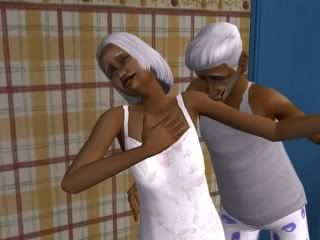 (They do have clothes, but ever since Goz retired and Pigeon moved back in to take over as Head of Household, they've basically been wandering around the house canoodling in their drawers. Actually they did a lot of that when he was working, too, but he was forced to get dressed and leave every day.)
And here's how they look in Aegerogropilon's Strangetown:
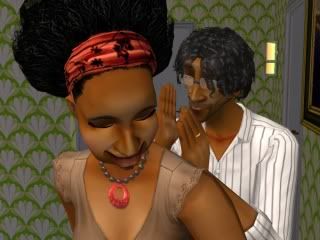
Sunday is Game with People Day, but I had time in the morning and evening that I could have used to blog. It wouldn't have been hard - even not feeling like working out a new one, I still have lots of old notes I could have pulled an idea from. We had e-mail working as of Saturday afternoon and I'd solved the last problem in the last major reinstallation - my Sims2 game - by around 10:00 Sunday morning.
So the truth is, I was desperate to get back to my neighborhood of little imaginary people. Because of the age of the most recent backup, I had three households to replay to get back up to where I'd left off, with important developments pending like a wedding, a child growing to teen-ager, and some new university graduates setting up housekeeping on their own - not to mention the baby about to be born, which I promised to name after the person on the newsgroup who helped me solve that last problem.
The newsgroup also factored in. It's a place where players hang out, help each other troubleshoot, and exchange pictures and gaming war stories, very much like any other gaming social venue, except that "war stories" are more likely to involve soap opera and juvenile hijinx than tales of heroism and high adventure. (Although players of the "zombie apocalypse" challenge have gone a long way toward making an adventure game out of a domestic simulator.) Not knowing any other players of this particular game, it's a natural place for me to indulge myself in nattering on, and posting really awful pictures for which I try to make up by explaining what's going on as amusingly as possible. People who post a lot will even generate a bit of a fanbase for particular sims, and I was surprised and gratified to find that this had happened to me. I'm sure nobody else was as anxious to get back to them as I was, but several people had kindly wished me well and expressed eagerness to hear what was going on in Drama Acres. Naturally I wished to oblige them.
One poster there has even exchanged copies of some of her sims with some of mine, we having both remarked that it was a shame her raucous Subject clan couldn't have playdates with my superfertile Hawkins family. I am still working out how to incoroprate the Subjects into Drama Acres, but I recently received some photos of how the Hawkinses she decided to add look in her game, and I keep returning to them. For one thing, I never got baby pictures of my beloved Pigeon Hawkins - now grown and with a toddler of her own in Drama Acres, but still an adorable rambunctious tot in Aegeropilon's Strangetown. For another, patriarch and matriarch Goz and Kitty Hawkins will be dying soon in my game, whereas in hers they are still young, with new and interesting hairstyles. Also, I started them with four children, and Aegeropilon is starting them with only two. With a little more time to breathe and different neighbors to interact with, they can develop differently, while still being, visibly and validly, the characters I created and love. Only now they're going beyond me, which is what I most want my creations to do.
It's a good feeling. A rewarding feeling. Compared to such ego gratification, the sense of an audience that "gets" what I'm saying, and the small but instant satisfactions of being recognized, the possibility of beating my way through the jungle of traditional publishing and maybe getting paid and maybe finding my audience, eventually, seems so remote and difficult that it's hard to gear myself up for it.
And this of course is the danger posed by online culture. Why labor in isolation to perfect a craft when you can garner a niche audience with imperfect fanfiction? Why go through the whole laborious process of publication when you can toss creations out on the web and gather praise from your particular subculture?
The answer, of course, is in all the unfinished fan serials and lapsed blogs out there. The audience loses interest when you get to the hard, long, uninspired slog in the middle. Ego gratification is not enough to tide you through the crisis periods when you just don't feel like posting, and will not be waiting for you when you're ready to come back.
And no one is going to pay you enough to live on, unless you're very very clever about it.
I'm still trying to figure out whether certain submissions got made in the crack between last backup and crash, or not, and I have a new query or two to get out. So I will do those things. They're important. I'm completely discouraged about my ability to sell in this market, but it's not because I doubt the works. I do good work. The problem is to get rewarded for it.
And I can't pay off the work on the house with ego gratification.
P.S. Just for grins, here's how Goz and Kitty Hawkins look in my game right now:
 (They do have clothes, but ever since Goz retired and Pigeon moved back in to take over as Head of Household, they've basically been wandering around the house canoodling in their drawers. Actually they did a lot of that when he was working, too, but he was forced to get dressed and leave every day.)
And here's how they look in Aegerogropilon's Strangetown:

Subscribe to:
Posts (Atom)
