I've always, always, always had to do things chronologically in the first draft, no bouncing around.
But this time, apparently, I have to bounce around. In time, in character, in emphasis. In everything. Between stuff I might theoretically get paid for and stuff no one will ever see but me (unless I become the subject of graduate work which isn't very likely and no one expects it) and stuff that may or may not ever even be relevant. It's not how I work.
But it is this time. And something vaguely story-shaped emerges from the mess.
And isn't some of this a substitute for piles of research, in a way? Since I can't research this one? Aren't I doing research in my own head?
We'll see, I reckon. In any case I don't seem capable of doing anything else, so - ride it out.
Showing posts with label goals. Show all posts
Showing posts with label goals. Show all posts
Tuesday, March 11, 2014


Thursday, December 19, 2013
Shhhhhhh....
Don't bug me. I feel crappy, but I think I've found the head of the thread that will sort out a plot problem that's been blocking me for years. I just have to unravel it a couple more chapters backward than I thought I would...and possibly write a bunch of stuff that can't go into the final version, working out what other people besides the POV character are doing. If I can sit up and focus long enough. This may be a job for longhand....
Tuesday, May 21, 2013
The Eternal Questions
Like, is it more important to work on the revision for something that you know where you're going to send it; or on yet another query to yet another agent?
Do I keep putting the revision work first because it's really more urgent, or because I hate writing queries so much? (Okay, that one's rhetorical.)
Why do I feel that citing Sullivan as my most recent work is somehow different from previous publications? Is there a good way to address my publication gap in a query? (This is one of the things that makes querying so hard.)
Am I in the process of reinventing myself as a YA author instead of one for middle grades?
Is it possible to do both anymore?
Has the washer stopped yet?
Is it too early to think about lunch?
Do I keep putting the revision work first because it's really more urgent, or because I hate writing queries so much? (Okay, that one's rhetorical.)
Why do I feel that citing Sullivan as my most recent work is somehow different from previous publications? Is there a good way to address my publication gap in a query? (This is one of the things that makes querying so hard.)
Am I in the process of reinventing myself as a YA author instead of one for middle grades?
Is it possible to do both anymore?
Has the washer stopped yet?
Is it too early to think about lunch?
Tuesday, April 9, 2013
Work Hygiene
So, I volunteered to take a bunch of craft stuff off a friend's hands and today I got another crafty friend over here and we went through it, making three piles - one for her, one for me, and one for a friend who LARPs. Naturally we discussed undone craft projects. And undone writing projects. And how digital scrapbooking distracted her from NaNoWriMo so she got an app that's intended to focus her on writing, but she got distracted by designing themes for it.
The whole trouble with computers is, that whereas you used to be able to shut yourself into a closet away from all distractions and write, now you shut yourself into a closet with your laptop to write and all the distractions follow you in there. But it's not the computer's fault. The computer gives you newer, shinier, high-tech ways to procrastinate, but they're all variations on things we've always done.
Everything we think of as optional is like this. We need to treat certain things as requirements. Like brushing our teeth or showering or making the bed. If you were raised to do those things, and life comes at you so hard that you don't for awhile, you know that life is out of control and you do something about it. Why? Because you feel uncomfortable, dirty, and miserable until you do. But brushing your teeth confirms that you are not, in fact, on the skids. My mom always made us take baths when we were sick, saying we'd feel better - and she was right. We weren't any healthier, but we felt less grungy and more as if we were going to get well sometime than we did before the bath.
We need to treat certain elements of work hygienically. Which ones will vary with the individual and the circumstance. My biggest needs are to update the ledger every time I spend or receive money instead of letting them pile up on the desk to be done all at once, and to write every day starting at eight o'clock. Sometimes I put off those things for something more urgent, but you know what? If my work hygiene has slipped, the urgent thing won't get done either; while if my work hygiene is good, the more urgent thing will get done later in the day. Having a prioritized list of things to do is a help with managing administrative, creative, social, and household duties.
However - there is always a however - there's also a point of diminishing returns. Brushing and flossing is good. Stopping dead after every single meal to brush and floss every single tooth is excessive. Having a list of things to do today is a good thing; having a list of things to do that is a little longer than you can do is not a bad thing; having lists of everything you want to get done and making sure you mark off every element of everything you do and add every new thing you realized also needs doing and break down all the steps of each project so you can cross it off later is a procrastination technique.
Here's a rule of thumb: if an individual act of hygiene goes for more than five minutes with no visible result - you're procrastinating. Quit it. Go do something useful.
The whole trouble with computers is, that whereas you used to be able to shut yourself into a closet away from all distractions and write, now you shut yourself into a closet with your laptop to write and all the distractions follow you in there. But it's not the computer's fault. The computer gives you newer, shinier, high-tech ways to procrastinate, but they're all variations on things we've always done.
Everything we think of as optional is like this. We need to treat certain things as requirements. Like brushing our teeth or showering or making the bed. If you were raised to do those things, and life comes at you so hard that you don't for awhile, you know that life is out of control and you do something about it. Why? Because you feel uncomfortable, dirty, and miserable until you do. But brushing your teeth confirms that you are not, in fact, on the skids. My mom always made us take baths when we were sick, saying we'd feel better - and she was right. We weren't any healthier, but we felt less grungy and more as if we were going to get well sometime than we did before the bath.
We need to treat certain elements of work hygienically. Which ones will vary with the individual and the circumstance. My biggest needs are to update the ledger every time I spend or receive money instead of letting them pile up on the desk to be done all at once, and to write every day starting at eight o'clock. Sometimes I put off those things for something more urgent, but you know what? If my work hygiene has slipped, the urgent thing won't get done either; while if my work hygiene is good, the more urgent thing will get done later in the day. Having a prioritized list of things to do is a help with managing administrative, creative, social, and household duties.
However - there is always a however - there's also a point of diminishing returns. Brushing and flossing is good. Stopping dead after every single meal to brush and floss every single tooth is excessive. Having a list of things to do today is a good thing; having a list of things to do that is a little longer than you can do is not a bad thing; having lists of everything you want to get done and making sure you mark off every element of everything you do and add every new thing you realized also needs doing and break down all the steps of each project so you can cross it off later is a procrastination technique.
Here's a rule of thumb: if an individual act of hygiene goes for more than five minutes with no visible result - you're procrastinating. Quit it. Go do something useful.
Tuesday, March 26, 2013
Rat Hard vs. Driving Hard
Once, I had a year from hell. So did everyone around me. That was one of the things that made it so hellish.
I had to finally learn to drive during that year, because Damon was too sick to do it and we couldn't afford to be dependent on our friends - who were also having hellish years and none of whom lived within a mile of us - for rides to the doctor. I found it enormously difficult, but I operated on the presumption that if I had to do something, I could do it, so I took driving lessons.
During the early part of that year, our cats, who are the worst hunters in the world, double-teamed a rat, chased it all over the house, and mortally wounded it. This was all deduced from forensic evidence - I had to clean up the rat blood. At first we assumed that the rat had eventually gotten away, but in a few days we realized that it had been mortally wounded. And died. Somewhere in the downstairs hall closet where Damon keeps his comic book boxes.
Damon at this time was bedridden, so while he slept I got into old clothes and rubber gloves, gathered "shovels and rakes and implements of destruction," and started taking the closet apart. Cleaning up deceased animals has always been Damon's job because I am a wimp, but I told myself I had to do this, so I could do it, so I gritted my teeth and got on with it.
And then I found the rat. And I couldn't.
I tried. Honest, I did. But it was as if a physical force field went up between me and it. I tried till I cried and I could not make myself do it. I couldn't even make myself use one of the long implements, much less reach into the closet with my rubber-gloved hands. After the first glimpse, I couldn't make myself look into the closet. I finally had to admit to myself that I had reached the limits of my strength and there was nothing to do but ask someone else to do the job I couldn't.
So I called M, our old housemate, who is completely unreliable about daily things like taking his turn at the dishes and getting his junk out of the high-traffic area and showing up on time for - anything - but who is completely reliable about responding to anyone he can interpret as a damsel in distress. M, I knew, would be delighted to clean up a dead rat so he could be my hero, if he happened to be at home. Which he was not. And his wife, who might or might not have been able to deal with a dead rat under normal circumstances, was home with the baby and a cold. But his brother happened to have dropped in on her, and he cheerfully came and cleared out the rat for me and I never had to look at or smell the thing again. And I had a new term in my personal vocabulary. A thing that is "rat hard" is too hard for me to do, even when I have to, and when I run up against that, then there's no point beating myself up about it. I just have to find another way.
The day after I discovered my limits that way, I had a driving lesson. We were getting down to the wire on the number of lessons I had left, and the instructor was teaching me to parallel park. This is a crucial skill to learn when driving in Texas, because if you can do it, you'd pretty much have to run over somebody to fail the rest of the test, and if you fail that, you fail the whole thing. Parallel parking is the first item in the test procedure and if you fail it they stop the test right there and you can go home to practice parallel parking some more. So we were out there in the empty parking lot with the cones and the imaginary Mercedes on either side and the problem was that I can't see straight.
It was before I learned why I can't see straight, but I'd known for years that I can't and it's one of the reasons I'd never bothered getting my license. However, I'd been walking under the influence of this peculiarity for most of my life and I found that most of my compensatory habits served me just as well in the car as when walking - until it came time to go in reverse. I was hopeless at going backwards. I couldn't tell when I was straight, I couldn't tell when I was turning, I couldn't tell where the bumper was, and I hit one or the other imaginary Mercedes every time. We spent half an hour just working on reversing and I just couldn't do it right.
At which point I put my head down on the steering wheel and told the instructor about the rat, ending the story with: "But this isn't like that. This is something I can learn to do."
And eventually I did do it, though it'd be a bit much to say I learned how to parallel park. I took me three tries to pass the driving test and I still can't line myself up parallel to and within the correct distance of the curb without someone outside the car giving me hand signals. In the eight years since then I've parallel parked "in the wild" exactly once - but I did it without hitting the other cars and that was all I asked of myself.
So that was another addition to my personal vocabulary. Impossibly steep learning curves are only "driving hard," and at the end of a horrible spell of failing and trying again and crying with frustration and failing and trying again and failing and crying and failing eventually, if I don't throw in the towel and declare defeat, I will get it done.
So the first question I ask myself when faced with something that's too hard is, Is it rat hard, or only driving hard? Because if it's rat hard, I need to stop wasting time and find the way around it; but if it's driving hard, it's time to move on to the second question; which is, How bad do I want it? Is it worth the effort and frustration and stress of learning to do it? Because if it's not, I need to stop wasting time working at it; but if it is, I need to get on with it.
I have never met a creative problem that was more than "driving hard."
Whether this story and this distinction do you any good, I don't know. Here they are for what they're worth.
I had to finally learn to drive during that year, because Damon was too sick to do it and we couldn't afford to be dependent on our friends - who were also having hellish years and none of whom lived within a mile of us - for rides to the doctor. I found it enormously difficult, but I operated on the presumption that if I had to do something, I could do it, so I took driving lessons.
During the early part of that year, our cats, who are the worst hunters in the world, double-teamed a rat, chased it all over the house, and mortally wounded it. This was all deduced from forensic evidence - I had to clean up the rat blood. At first we assumed that the rat had eventually gotten away, but in a few days we realized that it had been mortally wounded. And died. Somewhere in the downstairs hall closet where Damon keeps his comic book boxes.
Damon at this time was bedridden, so while he slept I got into old clothes and rubber gloves, gathered "shovels and rakes and implements of destruction," and started taking the closet apart. Cleaning up deceased animals has always been Damon's job because I am a wimp, but I told myself I had to do this, so I could do it, so I gritted my teeth and got on with it.
And then I found the rat. And I couldn't.
I tried. Honest, I did. But it was as if a physical force field went up between me and it. I tried till I cried and I could not make myself do it. I couldn't even make myself use one of the long implements, much less reach into the closet with my rubber-gloved hands. After the first glimpse, I couldn't make myself look into the closet. I finally had to admit to myself that I had reached the limits of my strength and there was nothing to do but ask someone else to do the job I couldn't.
So I called M, our old housemate, who is completely unreliable about daily things like taking his turn at the dishes and getting his junk out of the high-traffic area and showing up on time for - anything - but who is completely reliable about responding to anyone he can interpret as a damsel in distress. M, I knew, would be delighted to clean up a dead rat so he could be my hero, if he happened to be at home. Which he was not. And his wife, who might or might not have been able to deal with a dead rat under normal circumstances, was home with the baby and a cold. But his brother happened to have dropped in on her, and he cheerfully came and cleared out the rat for me and I never had to look at or smell the thing again. And I had a new term in my personal vocabulary. A thing that is "rat hard" is too hard for me to do, even when I have to, and when I run up against that, then there's no point beating myself up about it. I just have to find another way.
The day after I discovered my limits that way, I had a driving lesson. We were getting down to the wire on the number of lessons I had left, and the instructor was teaching me to parallel park. This is a crucial skill to learn when driving in Texas, because if you can do it, you'd pretty much have to run over somebody to fail the rest of the test, and if you fail that, you fail the whole thing. Parallel parking is the first item in the test procedure and if you fail it they stop the test right there and you can go home to practice parallel parking some more. So we were out there in the empty parking lot with the cones and the imaginary Mercedes on either side and the problem was that I can't see straight.
It was before I learned why I can't see straight, but I'd known for years that I can't and it's one of the reasons I'd never bothered getting my license. However, I'd been walking under the influence of this peculiarity for most of my life and I found that most of my compensatory habits served me just as well in the car as when walking - until it came time to go in reverse. I was hopeless at going backwards. I couldn't tell when I was straight, I couldn't tell when I was turning, I couldn't tell where the bumper was, and I hit one or the other imaginary Mercedes every time. We spent half an hour just working on reversing and I just couldn't do it right.
At which point I put my head down on the steering wheel and told the instructor about the rat, ending the story with: "But this isn't like that. This is something I can learn to do."
And eventually I did do it, though it'd be a bit much to say I learned how to parallel park. I took me three tries to pass the driving test and I still can't line myself up parallel to and within the correct distance of the curb without someone outside the car giving me hand signals. In the eight years since then I've parallel parked "in the wild" exactly once - but I did it without hitting the other cars and that was all I asked of myself.
So that was another addition to my personal vocabulary. Impossibly steep learning curves are only "driving hard," and at the end of a horrible spell of failing and trying again and crying with frustration and failing and trying again and failing and crying and failing eventually, if I don't throw in the towel and declare defeat, I will get it done.
So the first question I ask myself when faced with something that's too hard is, Is it rat hard, or only driving hard? Because if it's rat hard, I need to stop wasting time and find the way around it; but if it's driving hard, it's time to move on to the second question; which is, How bad do I want it? Is it worth the effort and frustration and stress of learning to do it? Because if it's not, I need to stop wasting time working at it; but if it is, I need to get on with it.
I have never met a creative problem that was more than "driving hard."
Whether this story and this distinction do you any good, I don't know. Here they are for what they're worth.
Tuesday, April 17, 2012
Even Vegetables are Growing All the Time
Spring is very frustrating to me - perfect weather for so many things, but not for my head. I'm all right if I have a project lined up to work on, as I can write sitting down; but starting a project is right out.
I can, however, open up the hatches and let in anything and everything that happens by to add to the compost bin of my mind and rot down into something that feeds a story later. I can't grow my own peas, but I can shell farmer's market peas on the back steps and watch the birds and cats. I can't go birdwatching, but I can turn on a blue heron cam. I can't learn new things very well (fly front zippers are hard enough when I can tell up from down), but I can pace myself through established things and make tank tops and even conduct small cooking experiments. And I can't solve major mysteries, but I can work out how many queries were sent in the crack between the last back-up and the computer crash. (One. And I even know who it was to!)
Next spring, however, I need to have a project lined up. It's never too early to plan these things.
I can, however, open up the hatches and let in anything and everything that happens by to add to the compost bin of my mind and rot down into something that feeds a story later. I can't grow my own peas, but I can shell farmer's market peas on the back steps and watch the birds and cats. I can't go birdwatching, but I can turn on a blue heron cam. I can't learn new things very well (fly front zippers are hard enough when I can tell up from down), but I can pace myself through established things and make tank tops and even conduct small cooking experiments. And I can't solve major mysteries, but I can work out how many queries were sent in the crack between the last back-up and the computer crash. (One. And I even know who it was to!)
Next spring, however, I need to have a project lined up. It's never too early to plan these things.
Thursday, April 12, 2012
The Paths of Temptation
It was pure lack of will that kept me from posting a garage sale idea last Sunday. I'll endeavor not to fail that saving throw again.
Sunday is Game with People Day, but I had time in the morning and evening that I could have used to blog. It wouldn't have been hard - even not feeling like working out a new one, I still have lots of old notes I could have pulled an idea from. We had e-mail working as of Saturday afternoon and I'd solved the last problem in the last major reinstallation - my Sims2 game - by around 10:00 Sunday morning.
So the truth is, I was desperate to get back to my neighborhood of little imaginary people. Because of the age of the most recent backup, I had three households to replay to get back up to where I'd left off, with important developments pending like a wedding, a child growing to teen-ager, and some new university graduates setting up housekeeping on their own - not to mention the baby about to be born, which I promised to name after the person on the newsgroup who helped me solve that last problem.
The newsgroup also factored in. It's a place where players hang out, help each other troubleshoot, and exchange pictures and gaming war stories, very much like any other gaming social venue, except that "war stories" are more likely to involve soap opera and juvenile hijinx than tales of heroism and high adventure. (Although players of the "zombie apocalypse" challenge have gone a long way toward making an adventure game out of a domestic simulator.) Not knowing any other players of this particular game, it's a natural place for me to indulge myself in nattering on, and posting really awful pictures for which I try to make up by explaining what's going on as amusingly as possible. People who post a lot will even generate a bit of a fanbase for particular sims, and I was surprised and gratified to find that this had happened to me. I'm sure nobody else was as anxious to get back to them as I was, but several people had kindly wished me well and expressed eagerness to hear what was going on in Drama Acres. Naturally I wished to oblige them.
One poster there has even exchanged copies of some of her sims with some of mine, we having both remarked that it was a shame her raucous Subject clan couldn't have playdates with my superfertile Hawkins family. I am still working out how to incoroprate the Subjects into Drama Acres, but I recently received some photos of how the Hawkinses she decided to add look in her game, and I keep returning to them. For one thing, I never got baby pictures of my beloved Pigeon Hawkins - now grown and with a toddler of her own in Drama Acres, but still an adorable rambunctious tot in Aegeropilon's Strangetown. For another, patriarch and matriarch Goz and Kitty Hawkins will be dying soon in my game, whereas in hers they are still young, with new and interesting hairstyles. Also, I started them with four children, and Aegeropilon is starting them with only two. With a little more time to breathe and different neighbors to interact with, they can develop differently, while still being, visibly and validly, the characters I created and love. Only now they're going beyond me, which is what I most want my creations to do.
It's a good feeling. A rewarding feeling. Compared to such ego gratification, the sense of an audience that "gets" what I'm saying, and the small but instant satisfactions of being recognized, the possibility of beating my way through the jungle of traditional publishing and maybe getting paid and maybe finding my audience, eventually, seems so remote and difficult that it's hard to gear myself up for it.
And this of course is the danger posed by online culture. Why labor in isolation to perfect a craft when you can garner a niche audience with imperfect fanfiction? Why go through the whole laborious process of publication when you can toss creations out on the web and gather praise from your particular subculture?
The answer, of course, is in all the unfinished fan serials and lapsed blogs out there. The audience loses interest when you get to the hard, long, uninspired slog in the middle. Ego gratification is not enough to tide you through the crisis periods when you just don't feel like posting, and will not be waiting for you when you're ready to come back.
And no one is going to pay you enough to live on, unless you're very very clever about it.
I'm still trying to figure out whether certain submissions got made in the crack between last backup and crash, or not, and I have a new query or two to get out. So I will do those things. They're important. I'm completely discouraged about my ability to sell in this market, but it's not because I doubt the works. I do good work. The problem is to get rewarded for it.
And I can't pay off the work on the house with ego gratification.
P.S. Just for grins, here's how Goz and Kitty Hawkins look in my game right now:
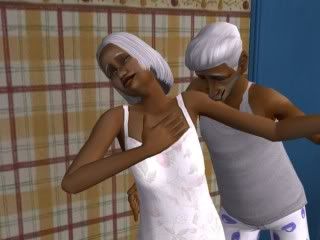 (They do have clothes, but ever since Goz retired and Pigeon moved back in to take over as Head of Household, they've basically been wandering around the house canoodling in their drawers. Actually they did a lot of that when he was working, too, but he was forced to get dressed and leave every day.)
And here's how they look in Aegerogropilon's Strangetown:
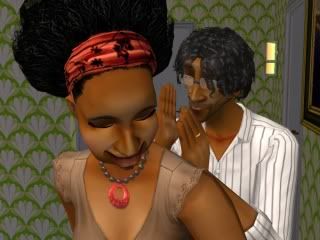
Sunday is Game with People Day, but I had time in the morning and evening that I could have used to blog. It wouldn't have been hard - even not feeling like working out a new one, I still have lots of old notes I could have pulled an idea from. We had e-mail working as of Saturday afternoon and I'd solved the last problem in the last major reinstallation - my Sims2 game - by around 10:00 Sunday morning.
So the truth is, I was desperate to get back to my neighborhood of little imaginary people. Because of the age of the most recent backup, I had three households to replay to get back up to where I'd left off, with important developments pending like a wedding, a child growing to teen-ager, and some new university graduates setting up housekeeping on their own - not to mention the baby about to be born, which I promised to name after the person on the newsgroup who helped me solve that last problem.
The newsgroup also factored in. It's a place where players hang out, help each other troubleshoot, and exchange pictures and gaming war stories, very much like any other gaming social venue, except that "war stories" are more likely to involve soap opera and juvenile hijinx than tales of heroism and high adventure. (Although players of the "zombie apocalypse" challenge have gone a long way toward making an adventure game out of a domestic simulator.) Not knowing any other players of this particular game, it's a natural place for me to indulge myself in nattering on, and posting really awful pictures for which I try to make up by explaining what's going on as amusingly as possible. People who post a lot will even generate a bit of a fanbase for particular sims, and I was surprised and gratified to find that this had happened to me. I'm sure nobody else was as anxious to get back to them as I was, but several people had kindly wished me well and expressed eagerness to hear what was going on in Drama Acres. Naturally I wished to oblige them.
One poster there has even exchanged copies of some of her sims with some of mine, we having both remarked that it was a shame her raucous Subject clan couldn't have playdates with my superfertile Hawkins family. I am still working out how to incoroprate the Subjects into Drama Acres, but I recently received some photos of how the Hawkinses she decided to add look in her game, and I keep returning to them. For one thing, I never got baby pictures of my beloved Pigeon Hawkins - now grown and with a toddler of her own in Drama Acres, but still an adorable rambunctious tot in Aegeropilon's Strangetown. For another, patriarch and matriarch Goz and Kitty Hawkins will be dying soon in my game, whereas in hers they are still young, with new and interesting hairstyles. Also, I started them with four children, and Aegeropilon is starting them with only two. With a little more time to breathe and different neighbors to interact with, they can develop differently, while still being, visibly and validly, the characters I created and love. Only now they're going beyond me, which is what I most want my creations to do.
It's a good feeling. A rewarding feeling. Compared to such ego gratification, the sense of an audience that "gets" what I'm saying, and the small but instant satisfactions of being recognized, the possibility of beating my way through the jungle of traditional publishing and maybe getting paid and maybe finding my audience, eventually, seems so remote and difficult that it's hard to gear myself up for it.
And this of course is the danger posed by online culture. Why labor in isolation to perfect a craft when you can garner a niche audience with imperfect fanfiction? Why go through the whole laborious process of publication when you can toss creations out on the web and gather praise from your particular subculture?
The answer, of course, is in all the unfinished fan serials and lapsed blogs out there. The audience loses interest when you get to the hard, long, uninspired slog in the middle. Ego gratification is not enough to tide you through the crisis periods when you just don't feel like posting, and will not be waiting for you when you're ready to come back.
And no one is going to pay you enough to live on, unless you're very very clever about it.
I'm still trying to figure out whether certain submissions got made in the crack between last backup and crash, or not, and I have a new query or two to get out. So I will do those things. They're important. I'm completely discouraged about my ability to sell in this market, but it's not because I doubt the works. I do good work. The problem is to get rewarded for it.
And I can't pay off the work on the house with ego gratification.
P.S. Just for grins, here's how Goz and Kitty Hawkins look in my game right now:
 (They do have clothes, but ever since Goz retired and Pigeon moved back in to take over as Head of Household, they've basically been wandering around the house canoodling in their drawers. Actually they did a lot of that when he was working, too, but he was forced to get dressed and leave every day.)
And here's how they look in Aegerogropilon's Strangetown:

Tuesday, September 20, 2011
The Happy Media
In one way, I am a fortunate individual. I always knew, and so did everyone around me, that I was going to write stories. And by always I mean, always. I was a writer before I could write things other people could read. This was so plain and obvious that everyone around me conceded it as a given, too. This or that individual person may not have thought I'd be any good, or that I'd make any money, or that it was a worthwhile endeavor - but nobody ever disputed that I would do it.
Not all writers know their destiny so well, or manifest it so clearly, from the git-go like that. They flounder in search of their purpose, or they are actively discouraged from it by those around them, or they mistake their calling and do something else for half their lifetime until the day they wake up and start writing, or realize they've been writing all along and it's time to take that somewhere.
I didn't, however, always know that I would write for young people. For a long time I thought I'd be one of those novelists who's also an academic (that was before I experienced academia and how little I am suited to it), or I'd write science fiction and fantasy, or - something. I had a leg up on my period of experimentation because I knew my medium and my skill, but I still had to find my subject and my audience. My niche only became clear after I had - first of all - realized that I prefer books written for young people to books written for adults, for the most part (and once I realized that most genre fiction is "really" YA, in that the qualities I enjoy in it are the same as the ones I enjoy in YA literature); and - second - that I did in fact write well enough to produce them.
This is another way in which I am fortunate. These two discoveries were easy enough to make, since I already knew what form my artistic expression would take and I could focus my experimentation on finding my niche within that form. A lot of people have to experiment on their form, their subject, their audience, and their genre all at the same time. Even more people are raised with the idea that they aren't creative, or that there's some qualitative difference between messing about with creativity, and actually being an artist, a writer, a musician, a dancer, or whatever.
Some people even have to muddle along without access to their form and audience. The world has more essayists now than at any time in the past, if we concede that bloggers are essentially essayists, freed from the limitation of needing someone to pay them to write essays for a periodical. The first people with a talent for programming computer games were born before computer games were invented. The modern world contains far more talented actors, scripters, costumers, prop builders, and effects artists than the related drama industries could ever support; hence the existence of historical recreation societies, cosplayers, and gamers. I've known many people for whom their game of choice is their creative outlet - on tabletop, playing field, or computer, they flower.
This is why fandoms proliferate. People who for one reason or another cannot use their native talent professionally can find it avocationally, in the company of a sympathetic audience, in the context of a fandom. Some of them pass through their fandom and come out the other side as a professional, and good for them (Cassandra Clare being a prominent current example, but hardly the only one). But many, many people do professional-quality work in the context of a fandom and never get paid; either because they never think of going pro, because they try and fail, because they're afraid they'll fail, or because they decide that the effort of going pro would spoil the activity for them. Sometimes it's because their talent lies in a niche so narrow that professionalism is unlikely, or unlucrative, or unacceptable - many gamers reject the restrictions that would be placed upon them, were they to enter the corporate structure of the gaming industry.
I happened to think about this in the context of poking around simblogs in an idle moment. (Okay, idle afternoon. Look, the floor's going to get clean; I was just a little giddy and needed a break. Of several hours.) People document their games online, with pictures, dialog, and snarky asides; make their favorite sims available for others to play; create new clothes, objects, even modifications to game code, investing hours not even playing their game, but playing with it. Their only audience is other players, but that's all right. They like it that way.
There's a person writing an extended fanfic about how a particular iconic neighborhood, with which everyone who plays Sims2 is familiar, got itself into the starting situation for that neighborhood. She writes it in chapters, formatted as screenshots from her game accompanied by blocks of text; and setting up the screenshots is obviously not a matter of playing the game at all, but of performing elaborate maneuvers with custom clothing, objects, modifications, and something called poseboxes to take a number of different pictures of the characters and then discarding most of them. Not too different from the process by which Dare Wright wrote The Lonely Doll and its sequels, in fact, except that this person has nothing tangible to work with, just a game designed for an entirely different purpose.
I can, just about, see how Dare Wright got pleasure out of her process. I can't see how "Skelljay" does; but I don't have to, either. Apparently, this is her medium and she likes working in it. It seems to me she could have finished the story by now if she hadn't mucked about with all those pictures but maybe she couldn't have. And maybe - who knows? How would we tell? - she's building skills in this medium that will enable her to be more profitably creative in another one. But if she's not, and she's satisfied, that should be enough for anybody.
But it raises the question: If you think you're not creative, is it because you haven't experimented enough and found your medium? Is it because, though you've found a medium, it seems silly to you?
I know that voice. Filking isn't really songwriting. Blogging about your hamster isn't really writing. Your elaborate macaroni sculpture isn't really art. You should do something more worthwhile with your time.
Don't listen to that voice. If something makes you happy, it is not a waste of time.
And if it brings pleasure to others, even just a small handful of others, it is a positive boon to society.
(While I'm doing this, let's have a couple of links to my two favorite simblogs, in one of which we get the story of Barkertown, the other of Ste. Margo. Warning: This game is rated T for Teen for a reason! Don't worry, you'll get most of the jokes and follow the story just fine without knowing the game.)
Not all writers know their destiny so well, or manifest it so clearly, from the git-go like that. They flounder in search of their purpose, or they are actively discouraged from it by those around them, or they mistake their calling and do something else for half their lifetime until the day they wake up and start writing, or realize they've been writing all along and it's time to take that somewhere.
I didn't, however, always know that I would write for young people. For a long time I thought I'd be one of those novelists who's also an academic (that was before I experienced academia and how little I am suited to it), or I'd write science fiction and fantasy, or - something. I had a leg up on my period of experimentation because I knew my medium and my skill, but I still had to find my subject and my audience. My niche only became clear after I had - first of all - realized that I prefer books written for young people to books written for adults, for the most part (and once I realized that most genre fiction is "really" YA, in that the qualities I enjoy in it are the same as the ones I enjoy in YA literature); and - second - that I did in fact write well enough to produce them.
This is another way in which I am fortunate. These two discoveries were easy enough to make, since I already knew what form my artistic expression would take and I could focus my experimentation on finding my niche within that form. A lot of people have to experiment on their form, their subject, their audience, and their genre all at the same time. Even more people are raised with the idea that they aren't creative, or that there's some qualitative difference between messing about with creativity, and actually being an artist, a writer, a musician, a dancer, or whatever.
Some people even have to muddle along without access to their form and audience. The world has more essayists now than at any time in the past, if we concede that bloggers are essentially essayists, freed from the limitation of needing someone to pay them to write essays for a periodical. The first people with a talent for programming computer games were born before computer games were invented. The modern world contains far more talented actors, scripters, costumers, prop builders, and effects artists than the related drama industries could ever support; hence the existence of historical recreation societies, cosplayers, and gamers. I've known many people for whom their game of choice is their creative outlet - on tabletop, playing field, or computer, they flower.
This is why fandoms proliferate. People who for one reason or another cannot use their native talent professionally can find it avocationally, in the company of a sympathetic audience, in the context of a fandom. Some of them pass through their fandom and come out the other side as a professional, and good for them (Cassandra Clare being a prominent current example, but hardly the only one). But many, many people do professional-quality work in the context of a fandom and never get paid; either because they never think of going pro, because they try and fail, because they're afraid they'll fail, or because they decide that the effort of going pro would spoil the activity for them. Sometimes it's because their talent lies in a niche so narrow that professionalism is unlikely, or unlucrative, or unacceptable - many gamers reject the restrictions that would be placed upon them, were they to enter the corporate structure of the gaming industry.
I happened to think about this in the context of poking around simblogs in an idle moment. (Okay, idle afternoon. Look, the floor's going to get clean; I was just a little giddy and needed a break. Of several hours.) People document their games online, with pictures, dialog, and snarky asides; make their favorite sims available for others to play; create new clothes, objects, even modifications to game code, investing hours not even playing their game, but playing with it. Their only audience is other players, but that's all right. They like it that way.
There's a person writing an extended fanfic about how a particular iconic neighborhood, with which everyone who plays Sims2 is familiar, got itself into the starting situation for that neighborhood. She writes it in chapters, formatted as screenshots from her game accompanied by blocks of text; and setting up the screenshots is obviously not a matter of playing the game at all, but of performing elaborate maneuvers with custom clothing, objects, modifications, and something called poseboxes to take a number of different pictures of the characters and then discarding most of them. Not too different from the process by which Dare Wright wrote The Lonely Doll and its sequels, in fact, except that this person has nothing tangible to work with, just a game designed for an entirely different purpose.
I can, just about, see how Dare Wright got pleasure out of her process. I can't see how "Skelljay" does; but I don't have to, either. Apparently, this is her medium and she likes working in it. It seems to me she could have finished the story by now if she hadn't mucked about with all those pictures but maybe she couldn't have. And maybe - who knows? How would we tell? - she's building skills in this medium that will enable her to be more profitably creative in another one. But if she's not, and she's satisfied, that should be enough for anybody.
But it raises the question: If you think you're not creative, is it because you haven't experimented enough and found your medium? Is it because, though you've found a medium, it seems silly to you?
I know that voice. Filking isn't really songwriting. Blogging about your hamster isn't really writing. Your elaborate macaroni sculpture isn't really art. You should do something more worthwhile with your time.
Don't listen to that voice. If something makes you happy, it is not a waste of time.
And if it brings pleasure to others, even just a small handful of others, it is a positive boon to society.
(While I'm doing this, let's have a couple of links to my two favorite simblogs, in one of which we get the story of Barkertown, the other of Ste. Margo. Warning: This game is rated T for Teen for a reason! Don't worry, you'll get most of the jokes and follow the story just fine without knowing the game.)
Tuesday, January 18, 2011
The Boring Part
Sorry about not hosting the garage sale Sunday. I had an idea to put on the block (there isn't the slightest danger of my running out), but - well, it was a weird weekend and it's not done with me yet, so it'll keep till next Sunday.
Meanwhile, it's almost the end of January. Have you:
Got your paperwork from last year in order?
Updated your ledger and started a new year?
Tracked down stray receipts?
Logged the mileage on the car you use for writing-related trips?
Added up the deductible mileage you put on it?
Renewed all your memberships in professional organizations?
Reported and paid any sales tax you owe?
Got everything in order so you can make your tax prep appointment as soon as the publishers, schools, and whatever get your forms to you?
Do you even have a tax preparer? It really is better not to do them yourself; not unless you're a CPA. And even then, are you sure you're up on the latest tax laws? 'Cause those suckers change all the time. Best to farm it out to people who do it all the time, especially if they guarantee themselves to eat the late fees if they make a mistake. It's way, way too easy to transpose two numbers on a form.
Yeah, it's all a mundane bore. But keeping up with the mundane crud is the only way to keep your castles in the air flying. Doing it now will be better than crashing and burning later.
Not that I would know about crashing and burning due to careless bookkeeping first hand, or anything.
Just trust me. Go do your petty officework and indulge yourself in an orgy of playful creativity, or chocolate, or both, afterward.
Meanwhile, it's almost the end of January. Have you:
Got your paperwork from last year in order?
Updated your ledger and started a new year?
Tracked down stray receipts?
Logged the mileage on the car you use for writing-related trips?
Added up the deductible mileage you put on it?
Renewed all your memberships in professional organizations?
Reported and paid any sales tax you owe?
Got everything in order so you can make your tax prep appointment as soon as the publishers, schools, and whatever get your forms to you?
Do you even have a tax preparer? It really is better not to do them yourself; not unless you're a CPA. And even then, are you sure you're up on the latest tax laws? 'Cause those suckers change all the time. Best to farm it out to people who do it all the time, especially if they guarantee themselves to eat the late fees if they make a mistake. It's way, way too easy to transpose two numbers on a form.
Yeah, it's all a mundane bore. But keeping up with the mundane crud is the only way to keep your castles in the air flying. Doing it now will be better than crashing and burning later.
Not that I would know about crashing and burning due to careless bookkeeping first hand, or anything.
Just trust me. Go do your petty officework and indulge yourself in an orgy of playful creativity, or chocolate, or both, afterward.
Friday, December 17, 2010
Zippers, agents, and other conundrums
I have now made, by my count, one rough draft and two complete pairs of slacks with fly-front zippers. I am now working on another rough draft to work out some more details of the fit; and by working I mean the pieces have been cut out for about a week and I got the four darts in yesterday. It took me a number of tries to do the darts, yesterday being a bad day for the gyroscope, so straight lines were hard and so was finding the right side of the nondescript cloth I'm using for the rough draft. I then tried to move on to the zipper, and couldn't do it.
The first three, successful, times I did this zipper I did it wrong first and, having done "wrong," was able to see how "right" would look, go back, and redo it. (Hint, always baste for the first try at a zipper.) This is time-consuming but it's not as if I'm on deadline here. Yesterday I put the thing together, pinned it, played a computer game, came back, stared at it some more, unpinned it, put it together again, and left off in despair. Every way seemed impossible and besides, the zipper is too long even though I cut it to the right size (I know it was the right size - I measured it). I'm hoping it's just the gyroscope screwing up my capacity to recognize spatial relations, which was never my strong suit anyway.
I've spent most of my life being treated as a smart person, because I read so much and because I don't let learning a new task daunt me. Within certain fields, I'm a quick study, and nine-tenths of learning a new thing is not getting intimidated by the onrush of new stimuli. A little methodical sorting, some focused concentration, and a well-placed question or two, and I'm good to go. I don't for a moment believe that I'm smarter than average, and the zipper thing proves it. I have to re-solve the problem every time and on some days I can't solve it at all, because it relies on a portion of my system that I never developed well and which is a little messed-up physically. I do not have the skill "insert a fly-front zipper." I have a skill set that enables me to insert a fly-front zipper, or work a complicated math problem, or whatever, given sufficient time and a way of checking the result.
In the same way, I do not have the skill "find a publisher." I'm not certain anyone does, though I know people I am willing to believe do if they cop to it. I have, without an agent, sold twelve books to major houses and a number of short pieces to a number of different venues; so I have a skill set that makes finding a publisher possible. As far as I can tell, finding an agent takes the same skill set.
What I lack is any way to check the result. I have this in common with practically everybody. The moaning and wailing goes forth from the internet daily: "But why did this agent/editor that should have wanted me reject me? What does this rejection mean?"
A rejection doesn't mean anything. The market for print media is shrinking and the supply for it gets bigger every year. Even twenty years ago when I started, when it was possible (I know; I did it) to send a complete manuscript to a major editor like Margaret K. McElderry and get it read, I knew - because I'd been studying for this role all my life - that works get rejected more often than they get accepted. There are a thousand reasons to reject a work and only one of them is "it stinks." Editors are overworked, overwhelmed, and underfunded. Most of them don't even have assistants anymore. Most of them didn't have first readers even when I started. Writing a helpful rejection is too big an addition to their workloads in most cases.
And now that agents are acting as first readers, everybody has to have an agent. But getting an agent is harder (at least, if you're me, the person with the solid mid-list background and crappy interpersonal skills) than getting a publisher. An editor only has to be able to convince a committee to believe your book will work as one element of a list in one year. An agent, to be effective, has to be in love with the book and your whole career as well as having a small enough client list to make room for one more who's going to take as much time and attention as you are.
This is a discouraging prospect for someone, like me, who hates meeting new people and distrusts salesmanship and who, at the time of assembling the query, isn't particularly in love with a project, myself. Generally speaking, by the time I've drafted a book, revised it into something resembling publishability, polished a hook, and crammed the whole into a one-page synopsis, I'm fed to the teeth with the thing. Having to write a query letter under those circumstances is like having to put in a zipper that will only work properly if I both set it up perfectly the first time and am feeling madly, passionately enthusiastic about wearing slacks at the time of sewing.
Under those circumstances, I'd never get a pair of slacks that fit. Ever. I wouldn't even try, because that's never going to happen. And I like wearing skirts. A lot of people never get well-fitted slacks and never mind it. I can, too.
But the stories I write are The Most Important Thing. Stuff other people consider vital to happy lives, I've given up in favor of writing stories and never felt as sacrifices. So I arm myself with the knowledge that how I feel isn't important, but getting an agent is; and I have the skill set; and I make the attempt anyway. Sure, I can fail. But the only way to fail permanently is to die or abandon the attempt.
I wouldn't do it if it weren't The Most Important Thing. I don't know why anybody would.
So that's my words of wisdom for this day without a gyroscope (when staying upright is a chore and I can't trust myself to write a query). Decide what The Most Important Thing is, and go for it. Everything else can fall by the wayside.
You can have more than one Most Important Thing, but they'd better be compatible.
The first three, successful, times I did this zipper I did it wrong first and, having done "wrong," was able to see how "right" would look, go back, and redo it. (Hint, always baste for the first try at a zipper.) This is time-consuming but it's not as if I'm on deadline here. Yesterday I put the thing together, pinned it, played a computer game, came back, stared at it some more, unpinned it, put it together again, and left off in despair. Every way seemed impossible and besides, the zipper is too long even though I cut it to the right size (I know it was the right size - I measured it). I'm hoping it's just the gyroscope screwing up my capacity to recognize spatial relations, which was never my strong suit anyway.
I've spent most of my life being treated as a smart person, because I read so much and because I don't let learning a new task daunt me. Within certain fields, I'm a quick study, and nine-tenths of learning a new thing is not getting intimidated by the onrush of new stimuli. A little methodical sorting, some focused concentration, and a well-placed question or two, and I'm good to go. I don't for a moment believe that I'm smarter than average, and the zipper thing proves it. I have to re-solve the problem every time and on some days I can't solve it at all, because it relies on a portion of my system that I never developed well and which is a little messed-up physically. I do not have the skill "insert a fly-front zipper." I have a skill set that enables me to insert a fly-front zipper, or work a complicated math problem, or whatever, given sufficient time and a way of checking the result.
In the same way, I do not have the skill "find a publisher." I'm not certain anyone does, though I know people I am willing to believe do if they cop to it. I have, without an agent, sold twelve books to major houses and a number of short pieces to a number of different venues; so I have a skill set that makes finding a publisher possible. As far as I can tell, finding an agent takes the same skill set.
What I lack is any way to check the result. I have this in common with practically everybody. The moaning and wailing goes forth from the internet daily: "But why did this agent/editor that should have wanted me reject me? What does this rejection mean?"
A rejection doesn't mean anything. The market for print media is shrinking and the supply for it gets bigger every year. Even twenty years ago when I started, when it was possible (I know; I did it) to send a complete manuscript to a major editor like Margaret K. McElderry and get it read, I knew - because I'd been studying for this role all my life - that works get rejected more often than they get accepted. There are a thousand reasons to reject a work and only one of them is "it stinks." Editors are overworked, overwhelmed, and underfunded. Most of them don't even have assistants anymore. Most of them didn't have first readers even when I started. Writing a helpful rejection is too big an addition to their workloads in most cases.
And now that agents are acting as first readers, everybody has to have an agent. But getting an agent is harder (at least, if you're me, the person with the solid mid-list background and crappy interpersonal skills) than getting a publisher. An editor only has to be able to convince a committee to believe your book will work as one element of a list in one year. An agent, to be effective, has to be in love with the book and your whole career as well as having a small enough client list to make room for one more who's going to take as much time and attention as you are.
This is a discouraging prospect for someone, like me, who hates meeting new people and distrusts salesmanship and who, at the time of assembling the query, isn't particularly in love with a project, myself. Generally speaking, by the time I've drafted a book, revised it into something resembling publishability, polished a hook, and crammed the whole into a one-page synopsis, I'm fed to the teeth with the thing. Having to write a query letter under those circumstances is like having to put in a zipper that will only work properly if I both set it up perfectly the first time and am feeling madly, passionately enthusiastic about wearing slacks at the time of sewing.
Under those circumstances, I'd never get a pair of slacks that fit. Ever. I wouldn't even try, because that's never going to happen. And I like wearing skirts. A lot of people never get well-fitted slacks and never mind it. I can, too.
But the stories I write are The Most Important Thing. Stuff other people consider vital to happy lives, I've given up in favor of writing stories and never felt as sacrifices. So I arm myself with the knowledge that how I feel isn't important, but getting an agent is; and I have the skill set; and I make the attempt anyway. Sure, I can fail. But the only way to fail permanently is to die or abandon the attempt.
I wouldn't do it if it weren't The Most Important Thing. I don't know why anybody would.
So that's my words of wisdom for this day without a gyroscope (when staying upright is a chore and I can't trust myself to write a query). Decide what The Most Important Thing is, and go for it. Everything else can fall by the wayside.
You can have more than one Most Important Thing, but they'd better be compatible.
Thursday, December 2, 2010
Cliff Jumped!
I wrote it yesterday. I read through it for a basic first proof this morning (I don't always do that, but with this book I need to) and it's bad. It's really bad. But that doesn't matter right now. Only the writing is bad; the logic and sequence and the choreography and the character actions are all fine. Writing I can fix.
So after reading through that I went on to the next bit, which is Di telling her secret, and I wrote up a storm. Which isn't surprising, since I've been writing that scene in my head for a couple of years now. Len started fishing during the conversation, which should have slowed me down because I know nothing about fishing, but all that was "business" to keep the reader anchored in time and place and situation. Alas, the escape from the bushwhackers left them without provisions. They have two canteens, a bag of beef jerky, some guns, and Len's fishing tackle minus any pole, and those creeks in the hill country don't grow a lot of cane for fishing poles. I can sort all that out later.
Sometimes I seem inconsistent to myself. Many and many a time a story has come to a grinding halt over details far more trivial than the fishing, and I can't proceed until I've winkled out exactly how such-and-such a thing is done, or would look, or would be achieved. Other times, however, I blast through like this. That's not a function of the details themselves, but of the context in which they're used. When I grind to a halt fretting about details in, say, a chase scene that has to end in a jump off a cliff, odds are good that the detail is not the thing that's stopping me. The detail is the thing I give my conscious mind to play with while my backbrain is working out the important stuff.
My conscious and subconscious were on the same page with Di's secret, as they'd been thinking about it every time she acted or spoke throughout the book. She's revealing the key to all her actions, here. If I didn't know that stuff, I wouldn't have gotten this far.
This'll be drafted by the end of the year, for sure.
So after reading through that I went on to the next bit, which is Di telling her secret, and I wrote up a storm. Which isn't surprising, since I've been writing that scene in my head for a couple of years now. Len started fishing during the conversation, which should have slowed me down because I know nothing about fishing, but all that was "business" to keep the reader anchored in time and place and situation. Alas, the escape from the bushwhackers left them without provisions. They have two canteens, a bag of beef jerky, some guns, and Len's fishing tackle minus any pole, and those creeks in the hill country don't grow a lot of cane for fishing poles. I can sort all that out later.
Sometimes I seem inconsistent to myself. Many and many a time a story has come to a grinding halt over details far more trivial than the fishing, and I can't proceed until I've winkled out exactly how such-and-such a thing is done, or would look, or would be achieved. Other times, however, I blast through like this. That's not a function of the details themselves, but of the context in which they're used. When I grind to a halt fretting about details in, say, a chase scene that has to end in a jump off a cliff, odds are good that the detail is not the thing that's stopping me. The detail is the thing I give my conscious mind to play with while my backbrain is working out the important stuff.
My conscious and subconscious were on the same page with Di's secret, as they'd been thinking about it every time she acted or spoke throughout the book. She's revealing the key to all her actions, here. If I didn't know that stuff, I wouldn't have gotten this far.
This'll be drafted by the end of the year, for sure.
Tuesday, November 23, 2010
Okay, Got It
I've been creeping up on the hard part of this book for awhile now. It wasn't making sense and it wasn't fitting together and what about this factor and that factor and no it wasn't going to work. But I kept writing, the next part and the next part and the next part, and Len kept riding, the next leg and the next leg and the next leg, and today I wrote myself up to the wall and then I stopped and stared at it.
And then I went and looked in some reference books.
And then I came back to the keyboard and laid it out how it was all going to happen. Once I took the dogs out, the logic began to work and I began to see it.
It'll still take me the rest of the week or longer to write it all and there are still bits I can't see, but that's okay. I'll see them when I need them. It won't be a big deal. And after that there's only the bits I've always known, the fate of the money belt and the secret sharing and the resolution. I could have this book drafted by the end of the year. I'll certainly be done before the end of January.
That's the thing about problems. Perspective works differently on them than on physical objects. If you keep coming steadily at them, they get smaller and smaller and smaller, until by the time you reach them, they're the right size to handle.
If more people understood this, they'd be less annoying to discuss problems with.
And then I went and looked in some reference books.
And then I came back to the keyboard and laid it out how it was all going to happen. Once I took the dogs out, the logic began to work and I began to see it.
It'll still take me the rest of the week or longer to write it all and there are still bits I can't see, but that's okay. I'll see them when I need them. It won't be a big deal. And after that there's only the bits I've always known, the fate of the money belt and the secret sharing and the resolution. I could have this book drafted by the end of the year. I'll certainly be done before the end of January.
That's the thing about problems. Perspective works differently on them than on physical objects. If you keep coming steadily at them, they get smaller and smaller and smaller, until by the time you reach them, they're the right size to handle.
If more people understood this, they'd be less annoying to discuss problems with.
Thursday, November 4, 2010
Sometimes Interruptions are Good
When I set goals, it's common for them to be disrupted by unexpected necessities. Normally I hate these. However, today I was interrupted by my husband telling me that the remaining balance on the porch work we did in 2008 (a two-week job that stretched to three months) was low enough to pay off. So off I trotted to the bank, wrote a check, and we now have a couple of weeks to enjoy owning our front porch before we take out the loan to fix the back, a much bigger job. Yay us.
And it didn't prevent my finishing revision of the last placeholder camel scene this morning or turning out and scrubbing the kitchen closet this afternoon, so even better. Currently the kitchen is strewn with stuff waiting for the interior to dry, because getting things clean always involves making a mess. There's a writing analogy in that somewhere.
There always is.
And it didn't prevent my finishing revision of the last placeholder camel scene this morning or turning out and scrubbing the kitchen closet this afternoon, so even better. Currently the kitchen is strewn with stuff waiting for the interior to dry, because getting things clean always involves making a mess. There's a writing analogy in that somewhere.
There always is.
Tuesday, November 2, 2010
Goals for the Week
I always have goals at the beginning of the week. I don't always fulfill them, but they give me a direction to head, anyway.
This week:
1. Vote. Accomplished.
2. Replace existing "placeholder" camel scenes with proper camel scenes while I still have all that fresh in my mind. Well begun, despite a certain lack of focus. I think that's an inevitable result of the way I've had to write this book - running ahead, falling behind, so I'm planning camel scenes and they get interrupted by love scenes and action scenes. Some of which will also be camel scenes (well, the action ones; not that camels aren't lovable). The main thing is, I'm working on it.
3. Begin Kitchen Sanitation Month by deliming the pots, cleaning the stove top to bottom, and starting on the ruthless turning out of cupboards. Um, no progress yet. There's reasons for that, but aren't there always? Tomorrow, I swear...
Kitchen Sanitation Month is an annual event for me since 2007. At the time I quit the day job, I was exhausted and had never gotten caught up on the jobs that the ball got dropped on during the Year from Hell two years before. So when I got up Monday morning, October 12, 2007 and told myself I was going to do exactly what I wanted to do from moment to moment for the entire week, I immediately threw myself into organizing my study. That took the rest of the month, and then I started in on the second most important room in the house, the kitchen. We won't talk about the scary stuff I found there, but it took the entire month of November, and I resolved never to let it get so bad again. However, in those kinds of moods I am a tough act to follow and I knew that the best will in the world, once the surge of freedom energy gave out, I wouldn't be able to actually maintain the kitchen at a satisfactory level, so - Kitchen Sanitation Month. If I turn out all the cupboards and scrub down all the surfaces at least once a year, at least I will never again be confronted by anything lodged in the back of the pantry that expired five years before.
November is actually a good month for this, as it's always better to have the kitchen pristine in time for Thanksgiving, so as not to give anyone food poisoning.
I'll check in later and see how I did with these goals. For today, have fun exercising the flab off your democracy and set some goals for yourself while you're at it. Let me know how you do.
This week:
1. Vote. Accomplished.
2. Replace existing "placeholder" camel scenes with proper camel scenes while I still have all that fresh in my mind. Well begun, despite a certain lack of focus. I think that's an inevitable result of the way I've had to write this book - running ahead, falling behind, so I'm planning camel scenes and they get interrupted by love scenes and action scenes. Some of which will also be camel scenes (well, the action ones; not that camels aren't lovable). The main thing is, I'm working on it.
3. Begin Kitchen Sanitation Month by deliming the pots, cleaning the stove top to bottom, and starting on the ruthless turning out of cupboards. Um, no progress yet. There's reasons for that, but aren't there always? Tomorrow, I swear...
Kitchen Sanitation Month is an annual event for me since 2007. At the time I quit the day job, I was exhausted and had never gotten caught up on the jobs that the ball got dropped on during the Year from Hell two years before. So when I got up Monday morning, October 12, 2007 and told myself I was going to do exactly what I wanted to do from moment to moment for the entire week, I immediately threw myself into organizing my study. That took the rest of the month, and then I started in on the second most important room in the house, the kitchen. We won't talk about the scary stuff I found there, but it took the entire month of November, and I resolved never to let it get so bad again. However, in those kinds of moods I am a tough act to follow and I knew that the best will in the world, once the surge of freedom energy gave out, I wouldn't be able to actually maintain the kitchen at a satisfactory level, so - Kitchen Sanitation Month. If I turn out all the cupboards and scrub down all the surfaces at least once a year, at least I will never again be confronted by anything lodged in the back of the pantry that expired five years before.
November is actually a good month for this, as it's always better to have the kitchen pristine in time for Thanksgiving, so as not to give anyone food poisoning.
I'll check in later and see how I did with these goals. For today, have fun exercising the flab off your democracy and set some goals for yourself while you're at it. Let me know how you do.
Subscribe to:
Posts (Atom)
